The last Allied troops left the Gallipoli Peninsula in January 1916. Within months, the recriminations had moved to Westminster. Winston Churchill, who as First Lord of the Admiralty had championed the naval attack on the Dardanelles, pressed for the release of government papers that he believed would vindicate him – a campaign that Maurice Hankey, secretary to the War Committee, privately judged was waged only to clear Churchill’s own character. Churchill was invoking a principle he had himself laid down from the despatch box as First Lord in November 1914: that while nothing should be published against the public interest, it would be ‘entirely wrong for a Department or a Minister to use the term “public interest” on naval and military matters in order to shield the Department or himself from blame or censure’. Then, in April 1916, a second imperial disaster: the besieged garrison at Kut el Amara in Mesopotamia surrendered. The death of Lord Kitchener, drowned when HMS Hampshire struck a mine on 5 June 1916, removed the Gallipoli campaign’s other central figure – and any prospect of hearing his account. On 18 July, Asquith told the Commons the documents could not be released, ‘without omissions so numerous and so important that the papers actually presented would be incomplete and misleading’. The admission satisfied no one. Facing defeat in the Commons, Asquith’s government conceded commissions of inquiry into both campaigns, established under the Special Commissions (Dardanelles and Mesopotamia) Act 1916.
The commission
The Dardanelles Commission was chaired by Lord Cromer, the former British Agent and Consul-General in Egypt. Its ten members included Andrew Fisher, the former Prime Minister of Australia, and Sir Thomas Mackenzie, New Zealand’s High Commissioner and former premier – recognition that the Dominions had paid a heavy share of the campaign’s cost – alongside parliamentarians and two retired senior officers, Admiral of the Fleet Sir William May and Field Marshal Lord Nicholson. When Cromer died on 29 January 1917, the judge Sir William Pickford took the chair.
The commissioners’ remit, set out in the Act, was sweeping: to inquire ‘into the origin, inception, and conduct of operations of war in the Dardanelles and Gallipoli, including the supply of drafts, reinforcements, ammunition and equipment to the troops and Fleet, the provision for the sick and wounded, and the responsibility of those departments of Government whose duty it has been to minister to the wants of the forces employed in that theatre of war’.
The commission heard 168 witnesses over 89 days between August 1916 and September 1917 – Churchill, Admiral Fisher, Sir Ian Hamilton, and scores of officers and officials. It sat in secret, and the evidence was never published with the reports. The reader is asked to accept the commissioners’ conclusions largely on trust.
Three reports
The First Report, on the origin and inception of the attack, was presented to Parliament on 12 February 1917 and published in March 1917 with passages excised; a short Supplement paraphrased what had been cut. The report found that Kitchener had run the War Office with so little reference to his general staff that the staff withered, and that the naval experts who doubted the plan – Fisher above all – never pressed their objections before the War Council.
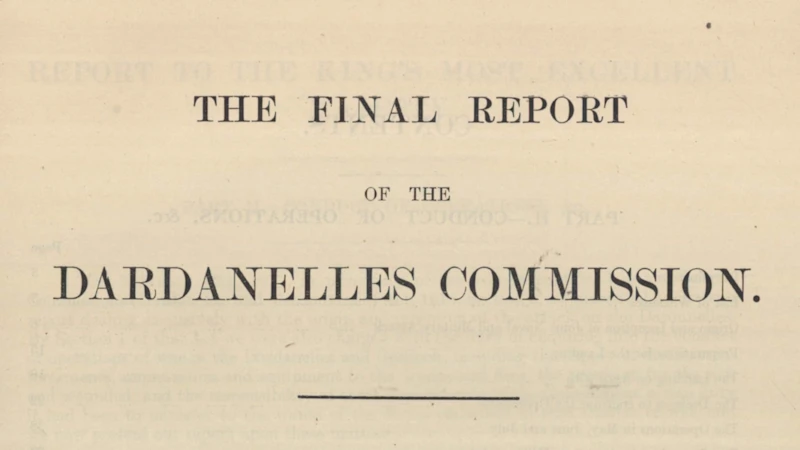
The Final Report, covering the conduct of operations from the landings of 25 April 1915 to the evacuation, was signed in December 1917 – and then suppressed. The War Cabinet declined to publish it while the war continued, on the ground that it would give information to the enemy. It appeared on 17 November 1919, a year after the Armistice; Parliament did not even debate it. (The delay left its mark on the printed page: the Final Report, though dated 1917, carries the command paper number Cmd. 371, from a numbering series that only began in 1919.)
Its judgements fell on planners and commanders alike. Kitchener and the War Council were faulted for launching the expedition without a proper military plan, and Sir Ian Hamilton for an over-complex August offensive and an ill-judged personal intervention at Suvla. The sharpest criticism of the fighting itself fell on the three Suvla generals – Stopford, Sitwell and Hammersley.
Reading it with care
The report is essential reading for anyone studying the campaign, but it is evidence to be weighed, not a verdict to be accepted. The historian Jenny Macleod, who traced the inquiry through Hamilton’s papers, called the result ‘purposefully bland’ – and showed the blandness was no accident. While the war continued, an official inquiry was never going to condemn commanders who still held office.
Official reluctance was on the record before the commission ever sat. In July 1916, opposing the release of the Dardanelles papers, the Chief of the Imperial General Staff, Sir William Robertson, warned that publication ‘would call attention to a story which brings little credit to our methods of conducting war’, and would damage British prestige in the East ‘where moral factors have more than ordinary weight’. The inquiry that followed operated inside those constraints.
The testimony it gathered has to be read the same way. Churchill assured the commissioners that ‘the right and obvious method of putting a British fleet into the Marmora was by an amphibious attack on the Gallipoli Peninsula. This view was general at the Admiralty – all my advisers shared it.’ The problem, he explained, was simply that ‘an army was wanted, and no army was forthcoming’. It is a lucid account – and the account of a man defending his judgement. Serving officers, for their part, held their tongues out of loyalty; Mackenzie noted in a supplementary report that witnesses could plainly have disclosed far more than they did. Hamilton himself, while professing to welcome the fullest publicity, worked hard behind the scenes: he obtained transcripts of the evidence of at least 31 witnesses, briefed his allies on what to say, and in one case forwarded a subordinate’s letter to the commission with its most damaging passage quietly omitted. Hankey coached many of the government’s witnesses. Hamilton also pressed the imperial argument: a report that made Australians and New Zealanders feel their sacrifices had been wasted would do lasting damage to the Empire.
The commission asked what had gone wrong and who was to blame, and gave its answers mainly in administrative and political terms. The Final Report follows the operations from the landing to the evacuation, and its narrative carries points of military judgement drawn from the witnesses – a failure put down to want of artillery, a general bemoaning the standard of staff work – but these come piecemeal, episode by episode, and never build into a sustained assessment of the fighting. Real analysis of the campaign would have to wait; and the commission stopped short of calling the enterprise an outright failure.
What was it worth?
Contemporaries could not agree on what the inquiry had achieved. Days after the Final Report appeared, the Morning Post’s military correspondent, Lieutenant-Colonel Charles à Court Repington – a lifelong ‘Westerner’ who had opposed the eastern ventures throughout the war – welcomed the ‘two honest and luminous Reports’ as confirmation of everything he had argued: the campaign would be taught in the war schools ‘as a typical example of how not to conduct amphibious enterprises’. The reports were honest and luminous to Repington partly because they agreed with him.
Those who had borne the inquiry’s demands took a dimmer view. Hankey, who had prepared his evidence late into the night while running the War Cabinet secretariat, told the House of Lords in 1940 – arguing against a similar inquiry in a new war – that ‘It is a very serious matter to draw into an inquiry of that kind ... the people who are at the moment engaged in conducting a great war, and I do not believe it is of any value whatever to the morale of the Government or of the Forces.’ His biographer Stephen Roskill agreed, dismissing the commission as ‘merely a prolonged post mortem’ conducted at a moment of crisis on every Allied front. None of these verdicts is disinterested, but between them they mark out the ground on which the commission has been argued over ever since.
That restraint, and that contested legacy, left the story of Gallipoli to be told elsewhere. Read the report, then, both as evidence about the campaign and as an artefact of the politics of 1916–1919.
A free searchable edition
Little Gully Publishing has produced a searchable PDF of all three parts – the First Report, its Supplement, and the Final Report with its appendix of documents and maps – in a single file of 253 pages, with bookmarks for navigation and a new OCR text layer that allows keyword searching across the whole inquiry.
Download the Dardanelles Commission reports (PDF, 22 MB)
The page images come from the copy held by the National Library of Australia, digitised through Trove, and we gratefully acknowledge the Library’s work in making them available. The NLA and other libraries offer their own digital copies; ours is a reader’s copy – the three parts combined in one document, with reliable search, at a size that downloads quickly. For full-resolution page images, go to the NLA.
Sources
Jenny Macleod, ‘General Sir Ian Hamilton and the Dardanelles Commission’, War in History, vol. 8, no. 4 (November 2001), pp. 418–441
Churchill in the Commons, 27 November 1914 (Royal Navy debate), in Robert Rhodes James (ed.), Winston S. Churchill: His Complete Speeches, vol. 3 (Chelsea House, 1974), pp. 2342–2343
Barry Gough, Churchill and Fisher: Titans at the Admiralty (Seaforth, 2017)
Geoffrey Miller, Straits: British Policy towards the Ottoman Empire and the Origins of the Dardanelles Campaign (University of Hull Press, 1997)
Stephen Roskill, Hankey: Man of Secrets, vol. 1 (Collins, 1970)
Lieut.-Colonel Repington, ‘The Dardanelles: A Cardinal Error’, Morning Post, 21 November 1919
Lord Hankey on wartime inquiries: House of Lords, 8 May 1940
Robertson’s note of 9 July 1916: The National Archives, CAB 42/16/4
Churchill’s statement to the commissioners: The National Archives, CAB 19/28
The parliamentary exchanges over publication in Hansard: the debate on the censored First Report, 7 March 1917, and the War Cabinet’s refusal to publish the Final Report, 10 January 1918
The commission’s evidence: The National Archives, series CAB 19
Acknowledgement
Thanks to Jim Grundy, who pointed us to several of the sources quoted above. Jim is the author of Hell & Confusion: Gallipoli Day by Day, a narrative of the campaign told in the words of those who were there; his second volume, Even The Most Savage Must Weep, is forthcoming from Little Gully Publishing.
Further reading
Founded upon hope: what the Dardanelles Commission didn’t ask – Jim Grundy’s response to this post
Can the Dardanelles be forced? What the General Staff said in 1906 – full transcripts of the 1906 memorandum and the Corbett letter