A guest post by Jim Grundy, author of Hell & Confusion: Gallipoli Day by Day – a narrative of the campaign told in the words of those who were there – responding to our post on the Dardanelles Commission reports.
The attempt to force the Dardanelles and the establishment of the Dardanelles Commission had one thing in common: they were both founded upon hope.
It was hoped ships alone could win through; that there would be no prolonged resistance to any landing; that a grand Balkan alliance would emerge; that establishing communications with Russia would shorten the war, somehow.
Investigating why none of that worked out gave key figures such as Churchill and Hamilton hope that their tarnished reputations could be salved; and Asquith’s opponents, such as the Northcliffe Press, hoped to find an even bigger stick to hit him with; and Lloyd George hoped to benefit if that stick landed.
Ultimately, Asquith’s already compromised coalition would collapse, rent by internal divisions. That left Churchill and Hamilton, in Hamilton’s words, ‘fated to have to fight for an idea – for a what might have been.’[1]
It was back to hope. What the Dardanelles Commission failed to probe was the foundation of all that fatal optimism. As the future Chief of the Imperial General Staff, Sir William Robertson observed:
There was no need to emphasize the advantages, and by constantly dwelling upon them there was a danger of obscuring the only points really at issue, namely, was the operation likely to succeed, and what might be the consequences if it failed?[2]

The Commission did note that the War Council had considered the warnings about the operation’s feasibility but its reasons for dismissing them were not explored.
... it was generally held by the War Council that the General Staff memorandum of 1906 was not wholly applicable to the conditions obtaining in 1915. There is no record of the precise reasons for this opinion.[3]
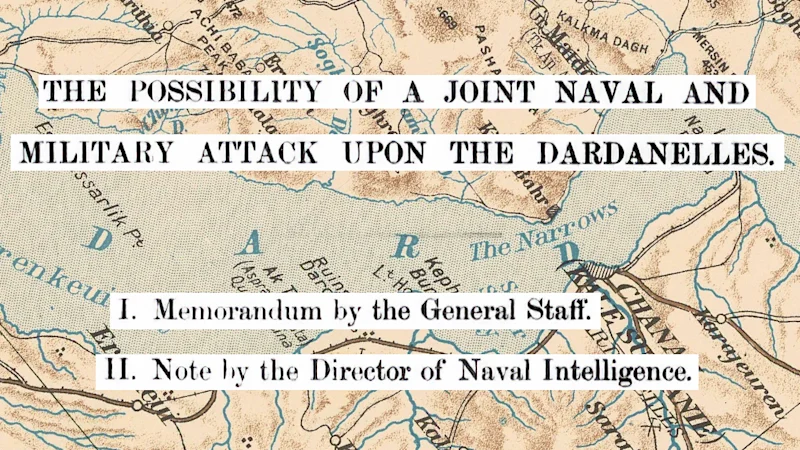
Major-General Charles Callwell was the lead author of that 1906 study. Did anyone ask him to give an updated appreciation? No.
Had those three admirals [Sir Arthur Wilson, Sir Henry Jackson and Lord Jackie Fisher], met three representatives of the General Staff, Sir J. Wolfe-Murray, General Kiggell and myself, let us say, sitting round a table with no Cabinet Ministers present, I am certain that the report that we should have drawn up would have been dead against the whole thing.[4]
One point the Commission might have profitably pursued was that of the timing of the War Council’s discussion of Callwell’s report. It was held on 19 February 1915, the very day when the naval bombardment of the Dardanelles forts began. The die had been cast and any doubts, had any been expressed, could not have been acted upon anyway. It is difficult not to conclude that the War Council had little interest in contradicting a decision it had already reached.
And, for Callwell, the most important lessons taught by the campaign were not for the benefit of sailors or soldiers but the politicians.
The most significant lesson taught us by the story of the [Dardanelles]... is not a lesson concerned with tactics, nor with strategy... It is not a lesson that needs to be instilled into the youngster at Dartmouth, nor at Woolwich, nor at Sandhurst... The lesson is one to be learnt by the statesman rather than by the fighting man ashore or afloat, and it amounts to this... rulers of a country must take exhaustive counsel with professional advisers, and they must see to it that those professional advisers are given full opportunity to state their case unhampered by political interference.
It is no use mincing matters about the Dardanelles. The discomfiture of the Allies in their campaign for the Straits was primarily due to their fighting forces having been committed to a ticklish adventure without adequate forethought... Hostilities between embattled nations are too serious a business to be conducted in this haphazard fashion.[5]
Those who looked to the Commission to open a Pandora’s Box of revelations were likely disappointed. All they had been left with was hope and that can be the cruellest fate of all.
The commission’s three reports – the evidence for much of the above – are free to download as a single searchable PDF: see our companion post, or go straight to the file itself (PDF, 22 MB).
Hamilton quoted in Jenny Macleod, Reconsidering Gallipoli, p. 32, Manchester University Press (Manchester) 2004.
↩William Robertson, Soldiers and Statesmen 1914–1918, Vol. 1, p. 95, Cassell & Company Ltd (London) 1926.
↩Dardanelles Commission. First Report, p. 8, HMSO (London) 1917.
↩C. E. Callwell, Experiences of a Dug-Out, pp. 92–93, Constable & Co. Ltd (London) 1920.
↩C. E. Callwell, The Dardanelles, pp. 332–333, Constable & Co. Ltd (London) 1924.
↩