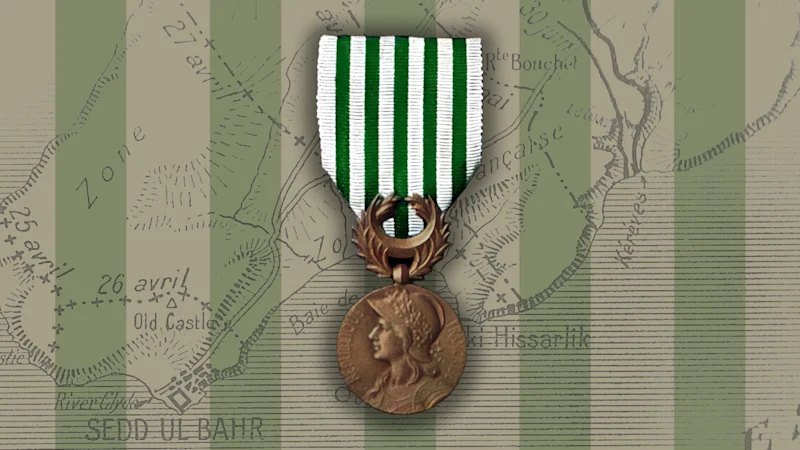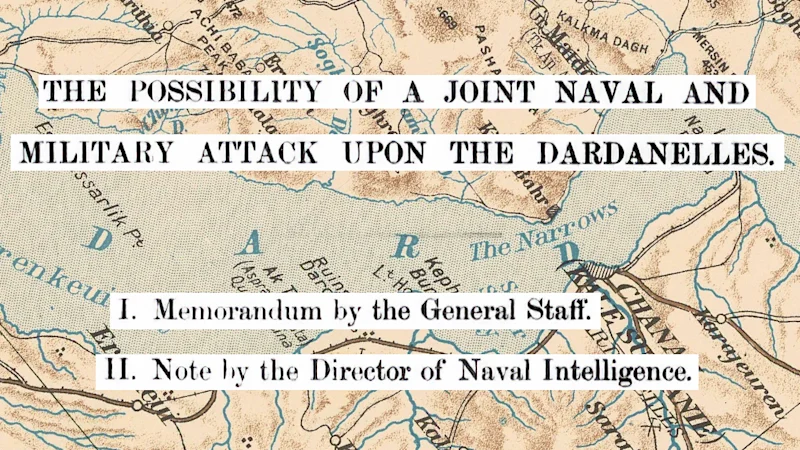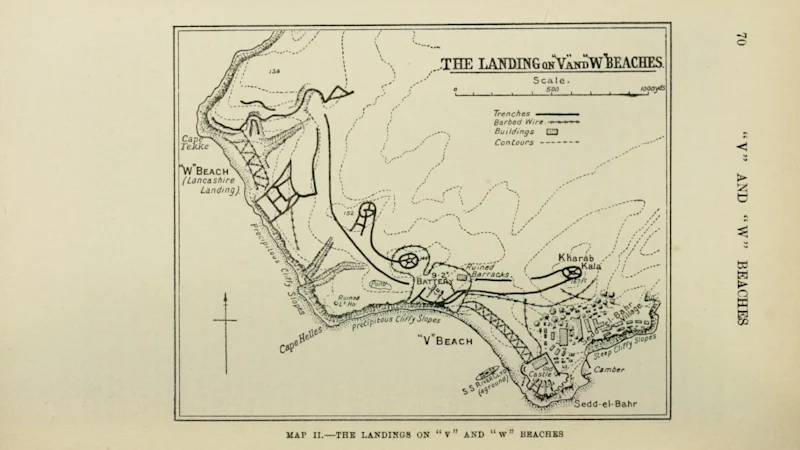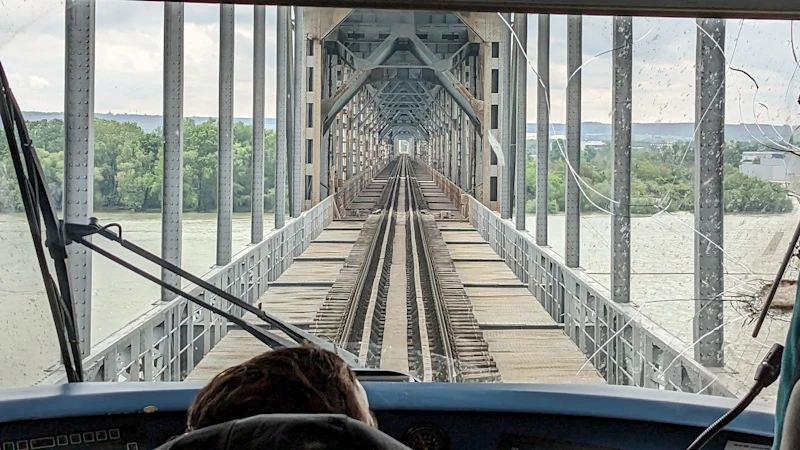
The sane traveller gets to Gallipoli by flying to Istanbul. The airport connects to most of the world, and Çanakkale is about four hours’ drive on new motorways. In April 2023 I went by train instead, as far as the trains would go.
The idea was to follow, at least in part, the railway that linked Berlin and Vienna with Constantinople during the First World War, with a few days in the French military archives in Paris and stops at museums and memorials further east. None of this was new ground. The Man in Seat 61 had already worked out the connections and how to buy the tickets. Not every connection worked as described, though. In the spring of 2023 international trains were not running through Serbia, and the detour through Romania took the route well away from the wartime line.
The Central Powers had a similar problem in 1915. When the Allies landed on 25 April, Serbia blocked the direct route, and Bulgaria and Romania were both neutral. Romania would not allow German munitions to cross its territory. Trains only ran through to Constantinople after Bulgaria joined the war in October and Serbia was overrun, from November 1915. The first regular passenger train, the Balkanzug, left Berlin for Constantinople on 15 January 1916, six days after the last British troops had left Helles.
London to Paris

The Eurostar left St Pancras early on 26 April, a day after Anzac/Gallipoli Day ceremonies in London, reaching the Gare du Nord at 9.40am. Paris was the research part of the trip: four days in archives spread around the edges of the city.
The Archives diplomatiques at La Courneuve holds some records of what France did on the peninsula after the war: the cemeteries, ossuaries and monuments at Helles, and the commemorations that followed. One file includes a design for a monument at the spot where General Henri Gouraud was wounded on 30 June 1915. It also holds the programme for the Paris commemoration of the 15th anniversary of the landing at Sedd-el-Bahr, on 25 April 1930, with photographs of veterans marching along the newly-named rue des Dardanelles.


LGP’s French commemoration at Gallipoli site lists more than 50 French cemeteries, monuments, ossuaries and tablets on the peninsula, and the 2,257 burials in the French military cemetery at Sedd-el-Bahr.
ECPAD, the defence ministry’s photograph and film archive, holds the army’s photographs of the Corps expéditionnaire d’Orient. It is in Fort d’Ivry, on the southern edge of Paris, and the fort’s dry moat is now allotments. Much of the collection can be browsed online.


The Service historique de la Défense (SHD), the archive of the French armed forces, is in the Château de Vincennes. Its Louis XIV reading room is a wonderful place to work, and the material on the Dardanelles is extensive. The files I came for covered French aviation at Gallipoli and the running of its bases on Tenedos and Lemnos. Among the intelligence files of 1915–16 is a report, stamped secret, that assesses the Anatolian coast between Samos and the Dardanelles as a landing place for 40,000 men. A separate section holds the air force’s photographs as printed copies, filed by subject in binders. Among them is a view of the airfield at San Stefano, outside Constantinople, in 1918; the site later became Istanbul’s Atatürk airport. A reader’s card can be arranged online, and documents are best ordered well ahead, as a date to consult them can take several weeks.


On 28 April, after the air and space museum at Le Bourget, the evening went on the Louvre, to see finds from Eleonte. The cemetery of this ancient Greek port lay under the French trenches at Helles. A Turkish shell exposed the first tomb in May 1915, and French soldiers excavated the site under fire that year and again in 1920–23. Most of the finds came to the Louvre, and some are on display in its Greek galleries.[1]
The next afternoon was spent at the Bibliothèque nationale de France (BnF), the national library, in its François-Mitterrand building beside the Seine. The reading rooms are well worth visiting. My reading was on the French army medical services at Gallipoli, but the library’s French books on the campaign cover much more, and many are hard to find or expensive to buy. The research rooms need a reader’s pass, which can be applied for online and collected on arrival.

I also went to see the rue des Dardanelles, the street in the 1930 photographs, in the 17th arrondissement. It was named in 1929 at the instigation of the Association nationale des groupements d’anciens combattants des Dardanelles, the national association of Dardanelles veterans’ groups.
That afternoon the train left the Gare de l’Est and crossed eastern France and the Rhine into Germany.

Paris to Munich and Ingolstadt
Munich was reached on the evening of 30 April. In the Hofgarten, the city’s war memorial commemorates the 13,000 men of Munich killed in the First World War. In a sunken crypt a soldier lies on a tomb. Bernhard Bleeker’s original figure was marble; the present one is a bronze cast made in 1972. The domed building behind the memorial was built as the Bavarian Army Museum and now houses the Bavarian State Chancellery.


The museum itself moved to Ingolstadt, an hour north, which was the next day’s stop. Its First World War collection, in the Reduit Tilly, part of the nineteenth-century fortress on the Danube, is remarkable for its range: art, uniforms, aviation badges, an observation balloon basket, and weapons, including captured ones such as a French trench catapult. Several things touch on Turkey. There is a model of the cruiser SMS Breslau, which reached Constantinople in August 1914 and served in the Ottoman navy as Midilli, still with her German crew, until mines sank her off Imbros in January 1918. There is the Ottoman war medal of 1915, the Harp Madalyası, which British soldiers called the Gallipoli star, and the tropical tunic of a medical NCO of the German troops sent to support the Ottoman army. Further afield is a British-made sun helmet worn by Oberstleutnant Franz Köhl of the Schutztruppe in German East Africa, the force the Zeppelin L 59 would set out to resupply from Bulgaria in 1917.


Across the river, the main museum in the Neues Schloss has the sleeping tent of Grand Vizier Sarı Süleyman Paşa, taken with the Ottoman camp after the battle of Mohács in 1687. The Bavarian elector, Max Emanuel, held a command on the winning side, when Bavaria was fighting the Ottomans rather than allied with them.

After an evening in a beer cellar, I took the midnight train to Budapest.
Munich to Budapest

The train reached Budapest Keleti at 10.21am on 2 May, leaving a day in the city. Most of it went on the Hadtörténeti Múzeum (military history museum) in the castle district of Buda, whose First World War exhibition opened for the centenary in 2016. Its cases hold cap badges, medals and orders, and uniforms of the Central Powers. Austro-Hungarian aviation is well represented, and the little-known Austro-Hungarian navy has a room of its own. The trench art includes a piece of limestone from the Isonzo front painted ‘Doberdói emlék 1915’ (souvenir of Doberdò). The allies are there too: an Ottoman fez, Ottoman award documents displayed with their medals, and a souvenir glass from 1914/15 with portraits of Kaiser Wilhelm II and Sultan Mehmed V.


The night train to Bucharest left that evening.
Budapest to Bucharest
The train ran through Transylvania by way of Sibiu, where we stopped at dawn. The rest of the morning was the Făgăraș mountains, still with snow on them, and then the Prahova valley down to the plain. We reached the Gara de Nord at about noon on 3 May. Outside the station is a memorial to Romanian railwaymen killed in 1916–18.


Romania stayed neutral until August 1916, when it joined the Allies. By the end of that year most of the country, including Bucharest, was occupied by German, Austro-Hungarian, Bulgarian and Ottoman troops. The Romanian army fought on from Moldavia in 1917.
There was one day to be had in the city, and most of it went on the Muzeul Militar Național (national military museum), founded by King Ferdinand in 1923. In the grounds, a line of rail wagons carries parts of two Austro-Hungarian siege howitzers built by Škoda. One is a 42cm howitzer that fired a 1,000kg shell. It was probably captured by Romanian troops in 1919, at the Škoda works in Győr, in Hungary. The other appears to be the 38cm howitzer ‘Gudrun’, which travelled on Ferdinand Porsche’s electric road train; its trailers could also run on rails. The aviation hall has a row of wooden propellers, one with a Viennese maker’s decal. Among the engines are a 160-horsepower Daimler and a British Siddeley Puma, the engine of the DH.9 bomber. There are also the remains of the aircraft in which Aurel Vlaicu was killed on 13 September 1913, trying to fly across the Carpathians, including its 50-horsepower Gnome engine. Hanging nearby is the wicker basket of a French Caquot observation balloon, of the model used by Romanian balloon companies in the First World War.

From the museum, a taxi went south to the Pro Patria cemetery on Șoseaua Olteniței. It is maintained by the German war graves commission and holds German and Austro-Hungarian graves from the First World War, German graves from the Second, and a plot of Bulgarian graves. The central monument carries the arms of the Central Powers, including two shields with the Ottoman crescent and star. The Ottoman VI Corps fought in Romania from the autumn of 1916.
My personal mission was to find the last resting place of a German pilot with an Australian connection. On 17 December 1917 Lieutenant James Sandy, who had served on Gallipoli as an artilleryman, and his observer, Sergeant Henry Hughes, of No. 3 Squadron, Australian Flying Corps, were spotting for British guns near Ploegsteert Wood when five Albatros scouts of Jagdstaffel 29 attacked their RE8. One Albatros came down in the Australian lines, and its pilot, Leutnant Rudolf Clauss, was captured with a bullet in his thigh. His aircraft is now in the Australian War Memorial. A single bullet passed through Hughes’s lung and into Sandy’s head, but their RE8 flew on with no one at the controls. It drifted about 80km on the wind, ran out of fuel near St Pol and landed itself in an open field, more or less intact. Clauss spent the rest of the war as a prisoner in Britain and served in the Luftwaffe in the Second World War. He died in Bucharest on 15 October 1941, apparently after a plane crash, and is buried at Pro Patria.[2] I searched the whole cemetery but could not find his grave.


On the way back the taxi passed the monument to the heroes of the air and the Arcul de Triumf. The arch is carved with the names of Romania’s battles, including Mărășești and Mărăști from 1917.


Bucharest to Veliko Tarnovo
The next morning I tried to book onward to Turkey at the Gara de Nord and got nowhere. The formidable woman at the ticket counter said no. Her advice was to get into Bulgaria and sort it out from there. So the next train was a local one south to Giurgiu, where the Danube forms the border. It crossed into Bulgaria on the Friendship Bridge to Ruse, and from Ruse the line runs on to Gorna Oryahovitsa, a major junction on the Bulgarian network.

Gorna Oryahovitsa was the next place to try for a ticket to Turkey, with no more success: there were no berths for two days. Rather than wait at the junction, I went on to Veliko Tarnovo, a short train ride away and a more hospitable place to be stuck. It was the capital of the medieval Bulgarian tsars, and Ferdinand proclaimed Bulgarian independence there in 1908. Near the station an inscription is cut into the rock face beside the road. It tells Bulgarians to remember that under Ferdinand they ‘liberated Macedonia’ on 29 November 1915 and the Dobruja on 4 January 1917. Bulgaria’s entry into the war in October 1915 was what opened the railway to Constantinople.


The two days went on the archaeological museum, the fortress hill, and football in a local bar over sliced cured meat and smoked cheese.
Veliko Tarnovo to Edirne
On the afternoon of 6 May the journey resumed. The train south from Veliko Tarnovo crosses the Balkan Mountains (Stara Planina) by way of Tryavna and comes down onto the Thracian plain at Stara Zagora. About 70km to the east is Yambol, which had the southernmost German airship base in Europe. In November 1917 the navy’s Zeppelin L 59, the Afrika-Schiff, set out from there with nearly 14 tonnes of ammunition, machine guns and medical supplies for Major General Paul von Lettow-Vorbeck’s force in German East Africa. It was recalled near Khartoum and was back at Yambol four days later, after 95 hours and 6,800km in the air. Eight months earlier, on the night of 20 March 1917, the army Zeppelin LZ 101 had flown from Yambol to bomb the Allied naval base at Mudros, on Lemnos. Its bombs did no damage beyond craters in gardens and vineyards. The same airship had bombed Bucharest on 27 August 1916, the night Romania entered the war.[3] There was no time to go and look.
There was little information at Dimitrovgrad, and we waited on the platform after dark in hope of the Sofia–Istanbul train. It arrived at about 10.50pm. The carriage in which I was shunted was old and basic. At the Turkish border at Kapıkule, in the middle of the night, everyone got off with their luggage and went through customs, then got back on.


The train reaches Edirne in the early hours. No one else was getting off, and the train does not always stop. The conductor of the sleeping car made sure it did, and I got down at about 2am onto an empty platform. The car park outside was deserted. A taxi number turned up online, and I had just enough Turkish to make the call. The taxi took me to a small hotel in the narrow streets of the old town, booked in advance, where someone had to be woken to let me in.
Edirne
Edirne, formerly Adrianople, was besieged by the Bulgarians in the First Balkan War and fell on 26 March 1913. The Ottomans recovered it that July. On the outskirts, now beside a motorway, is a reinforced-concrete hangar built in 1912 for a German-made observation balloon. During the siege there was not enough hydrogen to fly it. The hangar was later used for aircraft. On 24 October 1913 Lieutenant Nuri Bey flew from here to San Stefano, the airfield in the Vincennes photograph, in the first long-distance flight in Turkey. Across the field are the ruins of a nineteenth-century military hospital, used during the Gallipoli campaign. In May 2023 I visited the hangar with Kutalmış Bayraktar of Trakya University’s Faculty of Architecture, who has studied the building and is arguing for its reuse. It was empty apart from graffiti. It is now to be restored as the Turkish Aviation History Museum.[4]


The rest of the day went on the Edirne Balkan History Museum, a plate of tava ciğer (fried liver), the local dish, and a walk out to Karaağaç, across the Meriç. The museum is in the Hıdırlık bastion, one of a ring of bastions built around the city in the nineteenth century. During the siege it was the headquarters of the Ottoman commander, Mehmed Şükrü Pasha. It was restored and opened as a museum at the end of 2021. Karaağaç station was completed in 1914 to a design by Mimar Kemaleddin, one of the leading architects of the late Ottoman and early republican years. His portrait is on the back of the 20-lira note. The station served Edirne on the main line to Europe, and in the fields nearby are other railway buildings that have not been restored. The Treaty of Lausanne in 1923 gave Karaağaç to Turkey, but the railway on either side ran through Greece. Trains used the station under special arrangements until 1971, when a new line on Turkish territory opened. The building now belongs to Trakya University.


Edirne to Eceabat
There is no railway to the Dardanelles. On 8 May the 9.47am bus from Edirne bus station took the road south past Uzunköprü. A few kilometres to the west, the railway crosses the Maritsa (Meriç) into what is now Greece, at Kuleli Burgas, today Pythio. In November 1915 aircraft of the Royal Naval Air Service from Imbros, and seaplanes from HMS Ben-my-Chree, attacked the bridge at least seven times to stop German supplies reaching Constantinople. (The Ben-my-Chree’s later war is told in Floatplanes Over The Desert.) The first raid closed the line for 48 hours. On 19 November, during a raid on the nearby junction at Ferejik, Flight Sub-Lieutenant Gilbert Smylie was shot down. Squadron Commander Richard Bell Davies landed beside him and flew him out, for which Bell Davies was awarded the VC.
At Keşan there was a change to the Çanakkale bus, which crossed the 1915 Çanakkale Bridge, opened on 18 March 2022. Its main span of 2,023 metres is the longest of any suspension bridge. Its name, opening date and 318-metre towers all refer to the naval attack of 18 March 1915.


The bus finished in Çanakkale, on the Asian side. From there the ferry crosses back over the Narrows to Kilitbahir, a few kilometres from Eceabat, my final destination.


This route to Gallipoli is only for the bloody-minded.
Practical notes
Route (April–May 2023): London–Paris (Eurostar); Paris–Munich; Munich–Ingolstadt and back; night train Munich–Budapest; night train Budapest–Bucharest; Bucharest–Giurgiu–Ruse–Gorna Oryahovitsa–Veliko Tarnovo; Veliko Tarnovo–Dimitrovgrad; sleeper to Edirne; bus Edirne–Keşan–Çanakkale; ferry Çanakkale–Kilitbahir; minibus Eceabat.
Planning: much of this is the London to Istanbul rail route described by The Man in Seat 61 in ‘How to travel from London to Istanbul by train’, leaving the train at Edirne. The site covers every leg. Check whether trains are running through Serbia before planning the Romanian route.
Bulgaria: expect to wait for sleeper berths into Turkey.
Arriving in Edirne: the train reaches Edirne at around 2am and does not always stop. Tell the sleeping-car conductor.
Text and photographs by Bernard de Broglio, except archive documents as credited.
Notes
Bernard de Broglio, ‘Archaeology under fire’, The Gallipolian, no. 171 (2026), the journal of the Gallipoli Association. To find the objects, search ‘Eleonte’ in the Louvre’s online collection: https://collections.louvre.fr/en.
↩Aaron Pegram, ‘The Last Flight of the Albatros’, The ’14–’18 Journal, vol. 1 (2022): 20–29. Clauss’s death and burial are from his German war graves card (Deutsche Dienststelle, WASt).
↩Bernard de Broglio, ‘Zeppelin Raid on Mudros’, The ’14–’18 Journal, vol. 1 (2021): 3–17, the journal of the Australian Society of WW1 Aero Historians.
↩Bernard de Broglio, ‘Balloon Hangar Blues’, newsletter of the Australian Society of WW1 Aero Historians, August 2023, 24–28. The museum plan was reported in ‘Balkan Wars balloon base in Edirne to reopen as aviation museum’, Hürriyet Daily News, 15 February 2026, hurriyetdailynews.com.
↩