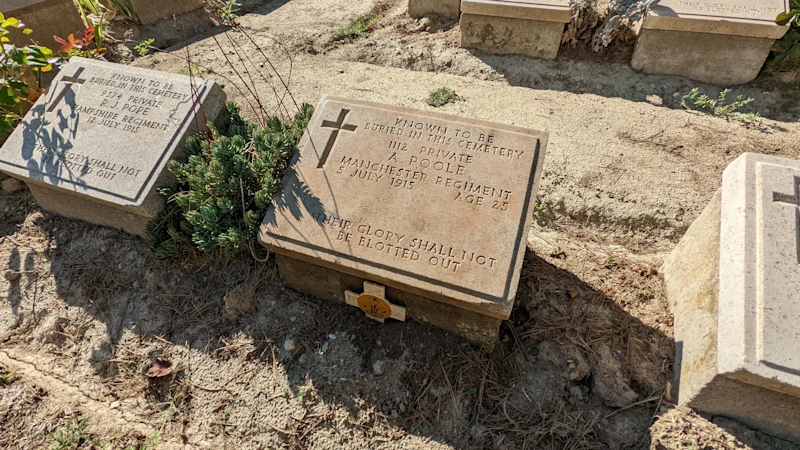
Private Arthur Poole, killed at Gallipoli, 5 July 1915
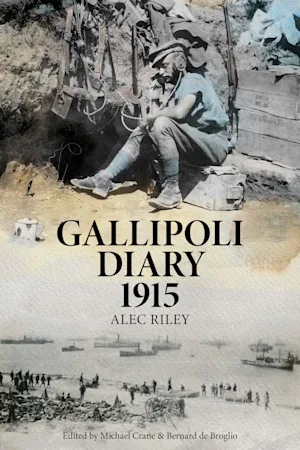
On the morning of 5 July, the Turks attacked the lines to the left of Krithia Nullah. Signaller Alec Riley was in a reserve trench when the shelling found them at 7.45am. ‘Business was brisk that early Monday morning,’ he wrote.
After a time, they thought they’d risk breakfast. Riley was at the telephone, so his friend Arthur Poole went round the traverse to boil some eggs and toast some cheese – Riley didn’t like eggs. Stanton, Ralston and Hargreaves were with him. A whiz-bang burst near the little fireplace and Riley heard Poole say, ‘If the Turks aren’t careful, they’ll crack these eggs,’ and everybody laughed. When the eggs were boiled, Poole handed them over: ‘Look sharp Serj! They’re hot.’
Then another shell arrived. A cloud of dust, shattered earth, dropping lead and iron. From round the traverse came the call: ‘stretcher-bearers!’ Riley asked, ‘Is it Poole?’ The answer was ‘Yes.’
‘Poole was lying on his back on the ground, with a ball through one of his eyes. He was dead.’

He was buried that day down at Krithia Nullah, the Rev. Kerby’s service short in the great heat, the men holding their helmets up to shade their necks. ‘None of us wanted breakfast,’ Riley wrote.
Poole’s watch, papers and photographs were parcelled up and sent, officially, through brigade and division, to his family. A dependant’s pension was later paid to his mother, Mrs Margaret Norbury Poole, of 30 Trafford Road, Eccles.

Private 1112 Arthur Poole, attached 1/1st Signal Company, Royal Engineers, formerly of the 6th Manchesters, was born in Longsight and lived at Eccles. He now lies in Twelve Tree Copse Cemetery, Special Memorial C. 25, not far from the nullah where his friends first laid him. He is also commemorated at St Andrew’s Church, Chadwick Road, Eccles.
In Manchester, Poole’s name appears on the memorial boards of the 6th Manchesters, which once hung in the battalion’s drill hall – now gone. The boards, under their sphinx and ‘Egypt’ battle honour, are today at University Barracks nearby.

A bronze plaque accompanies them, originally displayed in Mustapha Barracks, Alexandria; it records that the battalion was quartered there from 27 September 1914 to 19 January 1915, and embarked for Gallipoli from Alexandria on 3 May 1915. Two months after the battalion embarked, Poole was dead.

Riley’s account is one of thousands of small, exact human moments in Gallipoli Diary 1915.