Nine years before Gallipoli, in December 1906, the General Staff was asked whether the Dardanelles could be forced. Its answer was no – not by the fleet alone, and not by a joint expedition either, given the risks. Drafted by Major-General Charles Callwell and issued over the initials of Sir Neville Lyttelton, Chief of the General Staff, it was printed for the Committee of Imperial Defence (CID) as Paper 92-B. The Committee adopted its finding on 28 February 1907 – such an operation ‘would involve great risk’ – and the paper was withdrawn from circulation shortly afterwards.
On 19 February 1915 – the day the naval bombardment of the outer forts began – Prime Minister Herbert Asquith read extracts from the 1906 paper to the War Council. Lieutenant-Colonel Hankey, who had brought it forward, told the Council it was not exactly applicable to the present problem. The minute records some ‘more or less desultory discussion’ of how far it applied. Five days later Hankey circulated the full text, with a covering note and a letter he had commissioned from Julian Corbett on earlier attempts on the Straits.
Both documents are transcribed below in full. They follow our post on the Dardanelles Commission reports and Jim Grundy’s follow-up.
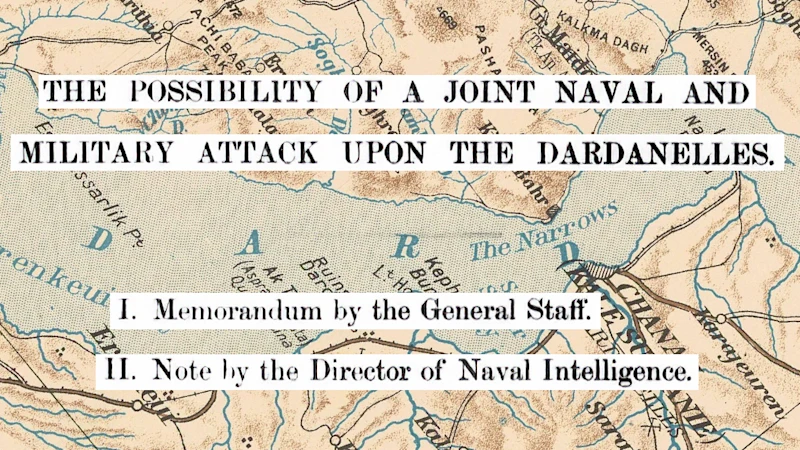
The possibility of a joint naval and military attack upon the Dardanelles
The National Archives, CAB 38/12/60. Printed for the Committee of Imperial Defence, February 1907. Secret. C.I.D. Paper 92-B. Catalogue entry
Note by the Secretary, 24 February 1915
[Hankey’s covering note, written when the 1906 paper was recirculated to the War Council. In the file at Kew it sits between the memorandum and the Director of Naval Intelligence’s remarks; it is placed first here.]
The enclosed C.I.D. Paper 92-B, dated December 20th, 1906, entitled “The Possibility of a Joint Naval and Military Attack upon the Dardanelles,” which was quoted from by the Prime Minister at a recent meeting of the War Council, is circulated for information.
1. This paper will not be found in the ordinary files of bound C.I.D. documents, as it was withdrawn from circulation shortly after being issued. The reasons for this withdrawal were that it was considered inexpedient at the time to have any document extant which indicated that coercion of Turkey was a matter of such difficulty.
2. The Memorandum has some bearing on problems now under consideration, though a great many of the factors have changed, particularly of the development of naval guns and gunnery, so that its conclusions cannot be regarded as entirely applicable to modern conditions.
3. A copy of a letter from Mr. Julian Corbett, who is working in the Historical Section of the C.I.D., and who was asked to give details of any former attempts on the Dardanelles, is also enclosed.
M.P.A. HANKEY
2, Whitehall Gardens, S.W.,
February 24, 1915.
Title page
THE POSSIBILITY OF A JOINT NAVAL AND MILITARY ATTACK UPON THE DARDANELLES
Printed for the Committee of Imperial Defence.
February 1907.
SECRET.
92 B.
I. Memorandum by the General Staff.
II. Note by the Director of Naval Intelligence.
2, Whitehall Gardens,
December 20, 1906.
Memorandum by the General Staff upon the possibility of a joint naval and military attack upon the Dardanelles
1. The General Staff has been in communication with the Naval Intelligence Department in regard to the wish expressed by the Committee of Imperial Defence that a thorough investigation should be jointly made into the whole question of the practicability of forcing the Dardanelles, either with or without the co-operation of an expeditionary force, as being the most certain and expeditious method of bringing a war with Turkey to a prompt and satisfactory conclusion.
2. Military opinion, looking at the question from the point of view of coast defence, will be in entire agreement with the naval view that unaided action by the Fleet, bearing in mind the risks involved, is much to be deprecated.
Even if, as has been suggested, it were feasible to rush a number of His Majesty’s least valuable ships past the batteries lining the Dardanelles and over the minefields which are believed to exist in the channel, their arrival off Constantinople would be no guarantee that the Sultan would be thereby brought to reason. His withdrawal, acting perhaps upon outside advice, from his capital, would place our squadron in an extremely awkward position.
A defenceless and undefended town, however otherwise important, offers no objective to ships of war. Without a large military force ready to land at a moment’s notice, there would be no means of controlling the populace and affording protection to the Christians of various nationalities who would be at the mercy of a fanatical mob. The Turkish communications furthermore between Europe and Asia would remain virtually intact, and our squadron might find itself face to face with the necessity of again running the gauntlet of the Dardanelles under circumstances which might lead to its destruction. Should such a reverse overtake any portion of our fleet whether in approaching to or returning from Constantinople, it does not seem probable that the type of vessel sacrificed would appeal very much to the Oriental mind. The news would at once spread through the whole Mohamedan world that the British Empire had experienced a serious humiliation at the hands of the Sultan.
3. A mere naval raid, therefore, into the Sea of Marmora being at once such a dangerous and ineffective operation, it must be taken for granted that, if ever an attempt to force the Dardanelles is made, the work will have to be undertaken by a Joint Naval and Military expedition having for its object the capture of the Gallipoli Peninsula and the destruction of the forts which at present deny entrance to and exit from these waters. The complete military occupation of this peninsula, coupled with the passage of the Dardanelles by a British fleet, would no doubt be a death-blow to the Sultan's power even if he were to quit Constantinople. His hold on his dominions in Europe, at all times precarious, would be gone; the main artery of communication between Asiatic and European Turkey would be severed, and, with freedom of access for our fleet to the Golden Horn secured, his return to his capital except as a suppliant for peace would be an impossibility. The General Staff, in fact, fully accepts the Admiralty view that few operations of sea power in combination with a moderate land force promise to be more effective in their final results than the seizure of the Dardanelles.
The governing factor, however, in the consideration of any schemes of coercion in relation to the Turkish Empire, is that success must be certain.
4. It is hardly necessary to point out that, even supposing this success to be assured, a policy based upon hostility to the head of the Mohamedan religion cannot fail to have very far-reaching military consequences for an empire which contains so many of the Sultan’s coreligionists. It becomes, therefore, all the more imperative to pause before undertaking any operation of war which might lead to British naval and military forces suffering disaster at his hands. It is indeed quite within the bounds of possibility that a reverse to a British fleet, or the repulse of an expeditionary force attempting to effect a landing upon Turkish soil, would be followed by a general uprising against British authority throughout the East. Any Government, therefore, which plays for the high stakes represented by a successful occupation of the Gallipoli Peninsula must carefully weigh, before deciding to act, the great military risks involved in the operation.
5. When the question of dispatching a military expeditionary force to the Gallipoli Peninsula comes to be passed in review, the first point to be considered is the general one of whether a landing is possible at all in face of active opposition under modern conditions. In regard to this, history affords no guide. The whole conditions of war have been revolutionised since such an operation was last attempted. Military opinion, however, will certainly lean strongly to the view that no landing could nowadays be effected in presence of an enemy, unless the co-operating naval squadron was in a position to guarantee with its guns that the men, horses, and vehicles of the landing force should reach the shore unmolested, and that they should find after disembarkation a sufficiently extended area free from hostile fire to enable them to form up for battle on suitable ground.
In the opinion of the General Staff a doubt exists as to whether the co-operating fleet would be able to give this absolute guarantee.
6. In contemplating a joint attack of this nature upon the Gallipoli Peninsula, it cannot be assumed that, by the time the expeditionary force arrived upon the scene of action, we should find the high ground in rear of the Dardanelles forts in the same state of unpreparedness for defence that it is at the present moment.
In the year 1897 the Turks threw up small earthworks commanding the landing places at two of the possible points of disembarkation, and, although these defence works are for the moment abandoned, it seems inconceivable that a state of tension between Great Britain and Turkey, followed by the dispatch of an expeditionary force to the Mediterranean, would not synchronize with the construction of elaborate earthworks on ridges of the Gallipoli Peninsula dominating all possible landing places, or that on the first threat of military action in any form a strong reinforcement would not be dispatched to the Turkish garrisons holding the defences of the Dardanelles.
It has been suggested that the attention of the military advisers of the Sultan might be distracted by feints and false alarms at other points on the Turkish coast. His Majesty’s solicitude regarding the safety of his front door is not likely to be diminished by noises elsewhere. Moreover, even if we credit the Turks with unpardonable stupidity, we cannot hope that their probable advisers would show the same want of perspicacity. If, therefore, it is decided to attempt a joint naval and military attack upon the Gallipoli Peninsula by an expeditionary force dispatched from the United Kingdom, with all the inevitable publicity of preparation for such an undertaking, it is as certain as anything can be in war that, however much our arrangements are veiled in mystery, however much we feint and dissemble, and wherever we fix our first rendezvous—be it in Egypt or elsewhere—a powerful force, possibly even 100,000, will be found ready to receive the joint expedition when it appears off the coast.
In this connection, we must not forget that, in the case of the Gallipoli Peninsula, we cannot exercise the discretion as to choice of a landing place, which is usually open to those who hold command of the sea.
7. It is true that, under one set of circumstances, the Gallipoli Peninsula might be found to be denuded of troops even at a time when this country was obviously meditating coercive measures against the Porte. Should, for instance, the Balkans be in a blaze, and should the Sultan be engaged in conflict with Bulgaria and with his Macedonian subjects, it is conceivable that an insufficient number of Turkish troops might be available to guard the Dardanelles. Such a condition of affairs would of course materially alter the military aspect of the problem here discussed, but in such a situation it seems almost impossible that British naval and military forces, even if they could be spared at the time for the purpose, could strike a vital blow at the Ottoman Empire without creating very serious international complications.
8. Setting aside, however, such a contingency as is suggested in the preceding paragraph, the successful conclusion of a military enterprise directed against the Gallipoli Peninsula must hinge, as already stated, upon the ability of the fleet not only to dominate the Turkish defences with gun fire, and to crush their field troops during that period of helplessness which exists whilst an army is in actual process of disembarkation, but also to cover the advance of the troops once ashore until they could gain a firm foothold, and establish themselves upon the high ground in rear of the coast defences of the Dardanelles.
However brilliant as a combination of war, and however fruitful in its consequences, such an operation would be, were it crowned with success, the General Staff, in view of the risks involved, are not prepared to recommend its being attempted.
9. It is so obvious that, after the many weeks which must elapse before an adequate expeditionary force could be assembled in Egypt, Cyprus, or elsewhere, ready to strike, a powerful Turkish army would be entrenched ready to confront it on arrival. That it has been a matter for further consideration and discussion whether a sudden coup de main executed by a comparatively small force, say, of 5,000 men embarked secretly at night by the fleet at Malta, and thrown ashore with the support of all the Marines, available seamen, and field guns of the fleet, would not have a better prospect of success than would be the case with a larger army.
Such a blow might conceivably be struck before the Turk had realized that the British people had come to the end of that stock of patience upon which he would confidently rely. But the risks of such an enterprise are obvious. Even if the actual landing were completely successful, and even if the appearance of the force in rear of the Abydos forts produced such a paralysis of the defence that the door was opened to the passage to Constantinople of some of His Majesty’s ships, the ability of the force either to extricate itself or to hold its own until further reinforced is more than open to question.
10. Moreover, apart altogether from the question of whether a landing upon the Gallipoli Peninsula in any given strength would or would not be a feasible operation of war, it may well be doubted whether the contingency of hostilities between Great Britain and Turkey alone, as contemplated in this Memorandum, is one which is ever really likely to arise.
It is useless to discuss the question of war with the Ottoman Empire without at the same time scrutinizing the probable attitude of other military Powers in the event of hostilities breaking out. Is it to be supposed, for instance, that Bulgaria would remain quiet? Would not the whole Near East be in commotion as a result of the crisis which had precipitated such a war? Could the quarrel be in any way localized? If not, and if Turkey were acting with support—and she would probably only defy Great Britain if she were sure of such support—would it be possible to dispatch our fleet and a striking force to the Mediterranean at all?
11. It is not disputed that the capture of the Gallipoli Peninsula would be a landmark in military history and a monumental illustration of the influence of sea power. On the other hand, it is an enterprise which might lead to the gravest military complications, the end of which no man could foresee, an enterprise full of risk and of risk which, with the tranquillity of our Indian Empire and Eastern possessions at stake, the General Staff would hesitate to accept.
12. If, then, the idea of an unaided Naval attempt to force the passage of the Dardanelles must be discarded, and if the project of a joint expedition, upon any scale, to the Gallipoli Peninsula is also set aside, the question arises as to what really can and ought to be done should hostilities between Great Britain and the Ottoman Empire become inevitable.
The reply seems to be that any military undertaking on a large scale directed against Turkish territory is almost forbidden by the lack of suitable objectives, and by the fact that the land forces of the Sultan are so vastly superior in numbers to any field army which we are likely to have at our disposal for offensive action.
An examination of the possible objectives open to an expeditionary force leads to the conclusion that no satisfactory objective exists. An attack upon Smyrna would carry the British army into the heart of the territory mainly peopled by the Osmanli race — Anatolia being essentially Turkish. An occupation of Salonika, although the forces likely to be encountered might not be so formidable as in the case of Smyrna, would raise the whole Near Eastern question, would arouse the alarm of Austria-Hungary, and would not lead to any tangible result however successful. A seizure of Tripoli might annoy Italy without seriously disturbing the Sultan. Operations upon the Red Sea littoral with the Holy Cities in view, however disconcerting they might be to His Majesty, are obviously impossible for a great Mohamedan Power like Great Britain to undertake.
The question of landing a military force at or near Haifa with the idea of occupying Acre and portions of Syria between Mount Carmel and the Jordan, has been carefully considered by the General Staff, but the conclusion arrived at is that, although such an operation does not present any serious difficulties in the first instance, its subsequent success is by no means well assured. An enterprise of this character could only be attempted by an expeditionary force including a powerful contingent of cavalry and artillery, and accompanied by all the impedimenta necessary to a large army in the field. A supreme effort of this kind may be justifiable, and may even be necessary, where some decisive object is in view, but it hardly seems wise to try a fall with a great Military Power in attempting an operation which, even if successful, would be little better than a pinprick to the Turkish Empire.
It may, of course, be conceded that if Turkey were really in a position to undertake a serious invasion of Egypt, and if such an enterprise hinged upon the safety of a line of communication which passed within the reach of an expeditionary force landed at Haifa, then the end in view would justify the risks involved in making the attempt. At present, however, the defence of Egypt in the event of trouble with the Ottoman Empire does not, in the opinion of the General Staff, present very serious difficulties.
As long as our command of the sea enables us to dispatch the reinforcements necessary to secure the tranquillity of the country and the safety of the Suez Canal, which should be our main line of defence, we have little to feel uneasy about. There seems, indeed, every reason to suppose that an invasion of Egypt by an organized Turkish army, capable of seriously endangering our position, is impossible unless and until a railway is constructed concurrently with the advance of the Sultan’s troops across the Sinai desert.
13. Practically therefore the conclusions to which the General Staff are drawn are these:—
(1.) That any policy of hostility to the Turkish Empire would add greatly to our military responsibilities in the East.
(2.) That active military coercion of the Sultan, with the forces at our disposal, involves risks which no Government should lightly incur.
(3.) That if pressure is to be exerted on the Porte, that pressure should be political, except in so far as the navy is able to co-operate by blockade, and by the seizure of islands.
(4.) That the defence of Egypt, though requiring careful consideration and study, gives at present no grounds for concern.
N.G.L.
December 19, 1906.
Remarks by the Director of Naval Intelligence on the attached memorandum
The Director of Naval Intelligence is generally in agreement with the General Staff Memorandum, and fully concurs as to the great risks involved in a joint naval and military enterprise against the Gallipoli Peninsula.
It is thought, however, that the Memorandum somewhat underrates the value of the assistance which might be rendered by a co-operating fleet by means of a heavy covering fire at the actual point of disembarkation, and during the stages of the advance immediately succeeding the landing, as well as by feints and diversions along the 45 nautical miles of littoral between the Bulair Lines and Cape Helles. The effectiveness of covering fire from men-of-war as an adjunct to the land forces was well illustrated by the Japanese attack on Kinchow, where the fire of the Japanese gun-boats turned the scale at the critical moment and enabled the attackers to force the left of the Russian position, while the torpedo-boats in rear of the Russian lines interrupted by their fire the passage of the trains in either direction (vide “Reports from Naval Attaches,” N.I.D., No. 755, page 86). In that operation the co-operating vessels were very small, and the fire they were able to develop was insignificant compared with what might be brought to bear in the Gallipoli Peninsula, where the hydrographical conditions are such that any number of vessels of the largest size and power could be employed to support the land forces.
It is thought, therefore, that if circumstances should arise to render an attack upon the centre of Ottoman power unavoidable, such as the closing of the Dardanelles to British merchant shipping and the seizure of our vessels, &c., an attack on the Gallipoli Peninsula could be carried to a successful conclusion, provided that the Government of the day were prepared to utilize a sufficient force for the purpose, and to incur heavy losses.
In a word, the sole difference between the General Staff and the Naval Intelligence Department in this matter is that, while the former appear to regard the enterprise in question as too hazardous to be attempted, the latter, while recognizing the great risks involved, is of opinion that it is within the bounds of possibility that an operation of this nature might be forced upon us by arrogance or outrage on the part of the Ottoman Government, and that, in such an event, there is no reason to despair of success, though at the expense, in all likelihood, of heavy sacrifice.
In order to facilitate a task of this arduous and difficult nature, the first necessity is, in the opinion of the Director of Naval Intelligence, to frequently practise joint naval and military manœuvres such as the rapid throwing on shore of a military force in the presence of an enemy, under cover of the guns of the fleet.
Printed at the Foreign Office by J. W. Harrison – 4/2/1907.

Letter from Mr Julian Corbett to Colonel Hankey, 1915
The National Archives, CAB 42/1/32. Printed for the Committee of Imperial Defence, February 1915. Secret. Also issued as G.5. Catalogue entry
[Corbett was working in the Historical Section of the CID and would later write the official naval history of the war. Hankey asked him for a note on earlier attempts on the Dardanelles; this is the reply, enclosed with the covering note above.]
Title page
Printed for the Committee of Imperial Defence. February 1915.
COMMITTEE OF IMPERIAL DEFENCE.
THE WAR.
The Dardanelles.
Letter from Mr. Julian Corbett to Colonel Hankey.
2, Whitehall Gardens, S.W.,
February 5, 1915.
The Dardanelles
SECRET.
February 4, 1915.
Dear Hankey,
This is in reply to your request for a note on our old attempts on the Dardanelles.
The leading case, of course, is Duckworth’s in 1807 — not pleasant reading, since it is the most conspicuous of the many failures of the “All the Talents” administration in war direction.
The object was to assist our ally Russia, who was bearing the brunt of the struggle against Napoleon, and against whom Turkey was being induced by French agents to declare war. To this end Duckworth was given a division of seven of the line from the Mediterranean Fleet with instructions that, if Turkey did not desist from hostilities with Russia, he was to demand the surrender of her fleet, and if they did not agree to this in an hour he was to take up a position which would enable him to destroy Constantinople and the fleet in the Golden Horn.
As a further means of assisting Russia our Government had promised, should Turkey declare war, to occupy Alexandria with a division from our garrison in Sicily.
Sir John Moore had just been sent out as second-in-command to General Fox at Messina and he at once put his finger on the weak point of the design. So strongly did he feel about separating the troops from the fleet and locking them up in Alexandria, that General Fox sent him to meet Duckworth at Malta to get his consent to the troops being held back for the present. “My opinion is,” Moore wrote in his Diary, “that the expedition to Alexandria is a mistake. It would have been well at present to have sent 7,000 or 8,000 men with the fleet to Constantinople, which would have secured their passage through the Dardanelles and enabled the Admiral to destroy the Turkish fleet and arsenal.”
He could do no more than obtain a respite till Duckworth had actually ascertained the state of affairs at Constantinople. On reaching the Dardanelles the Admiral found Turkey had declared war on Russia, and he had to send back word that our undertaking in regard to Alexandria must be made good. So the troops had to go there instead of to Constantinople.
The result was just what Moore anticipated. With a fair wind Duckworth was able to run the gauntlet of the batteries, destroying a cruiser squadron on his way, but as he carried on for Constantinople the wind fell, leaving him helpless eight miles away from the city.
In these circumstances, General Sebastiani, Napoleon’s agent, had little difficulty in persuading the Turks to turn a deaf ear to Duckworth’s overtures and menaces and to strengthen their fortifications for resistance. This they did not only at Constantinople, but also at the Dardenelles, till Duckworth, after waiting a week for a wind, was forced to retire before his retreat was entirely cut off. As it was, he was only just in time; in repassing the new batteries his fleet suffered severely.
The result was a very severe blow to our prestige in the Near East, and, what was worse, our relations with Russia were poisoned. So far from the operation strengthening the alliance, as was intended, the Czar began to give us up in despair, and a few months later signed the Peace of Tilsit with Napoleon.
The new British Government ordered Colingwood in person to the spot to repair the mischief, and before the signing of the peace of Tilsit was known he attacked the Dardanelles in concert with a Russian squadron under Admiral Seniavin, but being still without troops they were again defeated.
The best that can be said of the whole episode is that we learnt the lesson and did not again fall into the error which Moore had so clearly seen. Owing to the secret articles signed at Tilsit it became necessary to forestall Napoleon by treating Copenhagen as we had hoped to treat Constantinople. But in this case an adequate army accompanied the fleet, and the result was a brilliant success that entirely defeated and outwitted Napoleon.
If this does not throw sufficient light on the points you may have in mind I can give you further detail.
Yours sincerely,
JULIAN S. CORBETT.
Printed at the Foreign Office by C. R. Harrison – 10/2/1915.
Note on the transcripts
Both documents are transcribed as printed. Original spellings and punctuation are retained, including inconsistencies, and obvious slips in the originals are left uncorrected and unmarked – nothing here is flagged [sic]. Printer’s marks, page numbers and reference stamps have been omitted. Headings follow the originals.
The documents are Crown copyright – available under the Open Government Licence v3.0 – and held at The National Archives, Kew.
Sources
The possibility of a joint naval and military attack upon the Dardanelles, 20 December 1906 — TNA CAB 38/12/60
Letter from Mr Julian Corbett to Colonel Hankey, 4 February 1915 — TNA CAB 42/1/32
Minutes of the 96th Meeting of the Committee of Imperial Defence, 28 February 1907 — TNA CAB 38/13/12
War Council minutes, 19 February 1915 (13th Meeting) — TNA CAB 42/1/36