
Digital edition (PDF)
AUD $21.99
- Instant download after purchase
- Direct-from-source PDF (25MB)
- Direct from publisher, no retail markup
This PDF will be watermarked with your name and email for copyright protection. Single-user licence for personal use only. Copying disabled, low-resolution printing only.
Secure payment via Stripe
ISBN
- Paperback: 978-1-7640773-8-5
- eBook: 978-1-7640773-9-2
Book details
- Dimensions: 7 × 10 inches
- Pages: 436
- Illustrations: 46 maps and 19 illustrations
- Published: August 2026
Categories
Narrative history French forces Gallipoli Campaign
At the gates of the Dardanelles
The GHQ war diary of the French expeditionary corps, 1915
By Thomas P. Iredale (Translator)
About the book
The French at Gallipoli, in their own words. Translated into English for the first time, At the Gates of the Dardanelles presents the complete war diary — the Journal des marches et opérations — of the General Headquarters of the Corps expéditionnaire d’Orient, covering the campaign from pre-landing planning in February 1915 to the evacuation in December.
The daily entries record the landing at Kum Kale, the long grinding battles at Cape Helles, and the constant work of a corps headquarters at war: operational orders, intelligence summaries, artillery coordination, and the daily traffic between the French command and its British allies. The diary reveals a professional, well-led force whose contribution to the campaign has been all but absent from the English-language literature.
Thomas P. Iredale’s translation is annotated and extensively mapped, with appendices covering casualties, landings and evacuations — both an engaging read and a valuable work of reference. A foreword by Dr Edward J. Erickson, author of Gallipoli: The Ottoman Campaign, places the diary in its historiographical context.
Every copy unlocks the original French records behind the translation. Enter the access code printed in your book to download the complete GHQ diary as a searchable PDF — 351 pages, bookmarked by volume, with the seven volumes also available individually. The Pièces justificatives — the corps’ supporting documents from April to September 1915 – are included and likewise searchable. So are the complete page images of every item exactly as digitised, colour maps included, along with the Minute: the handwritten draft from which the fair copy was compiled.
Reviews
I wish that Thomas P. Iredale’s ‘At the Gates of the Dardanelles’ was available when I wrote ‘Gallipoli: The Ottoman Campaign’ in 2009. There is almost nothing in the English language historiography of the First World War about the French Army’s efforts against the Ottomans in 1915 … Tom’s new translation provides a massively overdue look at the tactical operations, planning, and logistics of the French expeditionary corps at Gallipoli.
The text has been annotated, providing valuable information about individuals and events as well as insights into the thinking of the French commanders … The CEO war diaries reveal a well prepared, well led, and professionally trained army at war.
Tom Iredale’s splendid addition to the field fills a critical void in how we in the English-speaking world should evaluate the Gallipoli Campaign. It will immediately become a “must have” for the bookshelves of historians, Gallipoli enthusiasts, and war gamers.
Dr Edward J. Erickson — from the foreword
Meet the trope that is true: the little examined, in the English historiography, role of the French at Gallipoli. Thanks to Tom Iredale, for the first time, we can now read the war diary of the Headquarters of the Corps expéditionnaire d’Orient, the ‘Journal des marches et opérations’.
The first impression is one of professionalism … Reference to 25th April reminds us that the French achieved the objectives set for them at Kum Kale; no other allied contingent could make that claim. It was particularly interesting to note how the French landed their field artillery, the famous 75s, right on the beach, giving direct fire support. We can contrast that with what happened at Anzac, where the landing of the artillery was delayed for fear the guns might be lost.
Everything is recorded in great detail as befits a professional military. The editor provides a mass of contextual information, useful maps and some fine photographs. Appendices list reinforcements, stores, ammunition landed throughout the campaign. They provide some real insights into what was required to maintain an army there.
Tom Iredale has given us access to a wealth of new information, for which historians should be forever grateful, shedding so much more light on the challenges faced by the French. ‘At the Gates of the Dardanelles’ belongs in every Gallipoli library. Highly recommended.
Jim Grundy — author of Hell & Confusion: Gallipoli day by day
The history of the French role in the Gallipoli Campaign is often lost among the stories of France’s allies. More than any other contingent that took part in the campaign, it was the French who best epitomized the concept of empire, with men in its ranks from all corners of the world. Alongside men from mainland France, there were soldiers from Algeria, Tunisia, Cameroon, Mauritius, Madagascar, Tahiti, Senegal, Guadeloupe, Martinique, Benin, Sudan, and Côte d’Ivoire.
For keen history students, the book ‘At the Gates of the Dardanelles’ offers a detailed account of the actions, battles won and lost, and casualties endured by the French forces, and in-depth data on the often-ignored importance of logistics in fighting a war. However, this is not just a book of reports and statistics; it is the story of over 80,000 men… It is their story—the suffering, the hardship, and the sacrifice in what was ultimately a defeat—told through the records of the CEO and a rich stream of footnotes that editor and translator Tom Iredale has helped bring to life.
Bill Sellars — Türkiye Today
Show all reviews Show less
Contents
Foreword by Dr Edward J. Erickson
Translator’s Preface
Notes on the Translation
Chapter I: Organisation of the Corps expéditionnaire d’Orient
Chapter II: Concentration at the base on Lemnos
Chapter III: Organisation of the base on Lemnos
Chapter IV: CEO main force concentrated in Alexandria
Chapter V: Tasks on Lemnos during the Alexandria period
Chapter VI: Preparations for the landings
Chapter VII: The landings, 25–26 April
Chapter VIII: April and May
Chapter IX: June
Chapter X: July
Chapter XI: August
Chapter XII: September
Chapter XIII: October
Chapter XIV: November
Chapter XV: December
Appendix I: Casualties, 25 April – 30 September
Appendix II: Landings and evacuations
Glossary
Bibliography
Reader Download Page
Show all contents Show less
From our blog
View all posts →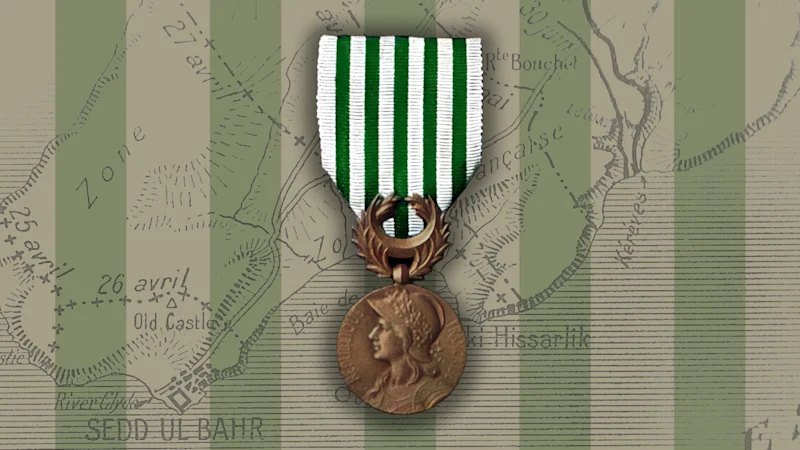
The medal France struck for the Dardanelles
The story of the médaille commémorative d’Orient, the only Gallipoli campaign medal.
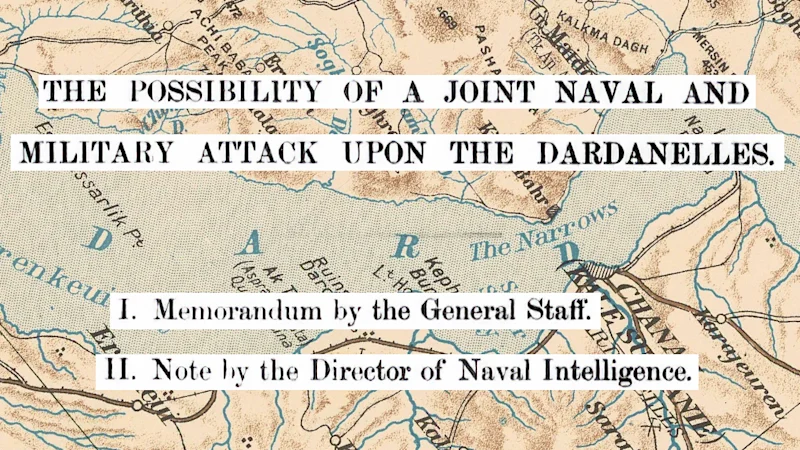
Can the Dardanelles be forced? What the General Staff said in 1906
Nine years before Gallipoli, a secret War Office paper ruled out forcing the Dardanelles – by the fleet alone, or with an army landed on the peninsula.
Recommended for you
View all books →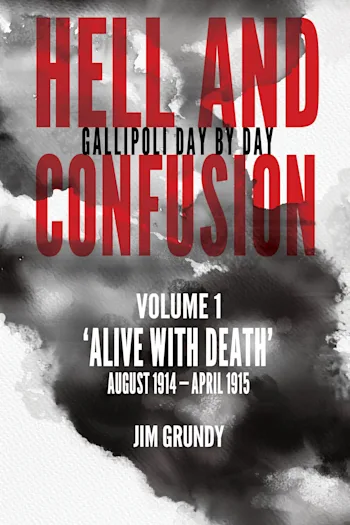
Walking in Their Grave Clothes : An Australian nurse’s war diary, 1914–1918
Read more →

Letters from Helles : The uncensored correspondence of a battalion commander at Gallipoli
by Colonel Sir Henry Darlington
Read more →
Floatplanes Over The Desert : The Adventures of French & British Naval Airmen Over Sea & Desert Sand 1914-1918
by Ian M. Burns
Read more →