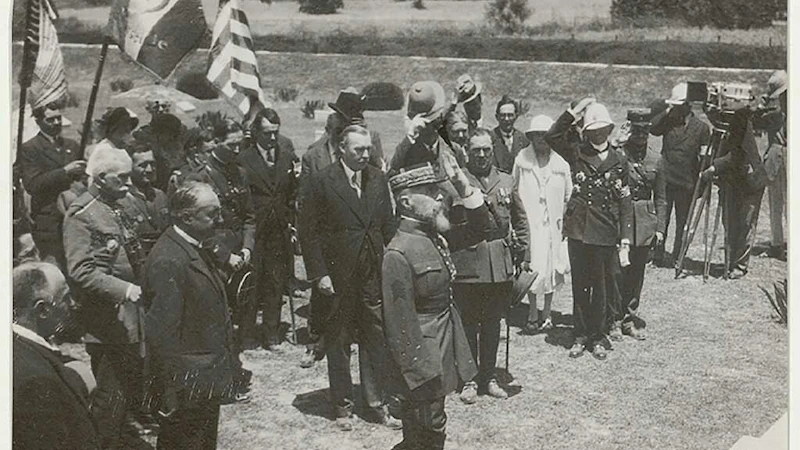
On 9 June 1930, General Henri Gouraud stood before the newly completed French memorial at Sedd-el-Bahr, on the tip of the Gallipoli peninsula, and addressed a gathering of veterans who had returned to the battlefields where they had fought fifteen years earlier.
Gouraud knew the ground intimately. He had commanded the Corps Expéditionnaire d’Orient during some of the fiercest fighting of the 1915 campaign, and was himself severely wounded there in June of that year.
Gouraud’s address was published in the Revue des Deux Mondes (vol. 58, no. 1, 1 July 1930, pp. 204–208). The translation below is ours.
For more on French memorials and cemeteries at the Dardanelles, visit our companion site, French commemoration at Gallipoli.

General Gouraud: To the Dead of the Dardanelles
Address delivered on 9 June 1930 at the inauguration of the monument at Sedd-el-Bahr
My dear comrades-in-arms,
How deeply moved we are to stand once more before this landscape, unchanged since those tragic days!
Beyond lie Seddul-Bahr and its beaches, where shells once fell as thickly as on the frontline; yonder, the cypresses where, one June day, we buried General Ganeval to the sound of a furious cannonade on the British front; the pylons and Zimmermann Farm. At our feet lies Morto Bay; the dugouts and shelters where I once reviewed the magnificent 6th Colonial Regiment under Colonel Noguès; the ridge of Eski Hissarlik, where heavy shells crashed down amid the beauty of those evenings of the Orient. Further north are those corners of the battlefield that were so fiercely contested: the Rognon, the Quadrilateral, the Haricot, the approaches to Kerevez Dere.
Further off is the height of Achi Baba, which loomed so closely over us that I was forced to hold my reviews at night to present decorations won in action. And over there, on the coast of Asia, were the emplaced batteries of In Tepe, which completed the circle of fire around us.
To be sure, during the years that separated us from those heroic times, our thoughts often turned to our comrades who rest in Turkish soil; but the Nation owed it to herself to raise a monument to their memory. And we, the survivors, are likewise fulfilling a duty. Allow me to thank your devoted president, Colonel Weisweller,[1] for having so ably organised our pilgrimage, and to congratulate Monsieur André George, the Architect and Curator of the French Embassy; the monument his artistry has created is truly worthy of our Dead.
Henceforth, ships passing offshore will see, rising from this soil drenched with so much French blood, the lofty column that shall proclaim forever France’s fidelity to those who sacrificed themselves for her.
To all of them – the men of the 175th Infantry Regiment, of the 176th, Zouaves, Legionnaires, Colonial troops of the 4th and 6th, Senegalese, Chasseurs d’Afrique; gunners of the 75s, the 155s and the 240s, of the trench mortars; sappers, airmen, sailors. All these brave men – soldiers of General Masnou, killed in action alongside his admirable Chief of Staff, Commandant Romieux; of Colonel Vendenberg, wounded; of General Bailloud; of General Ganeval, killed; of General Girodon, wounded. The sailors of Admiral Guépratte, and the sailors of the Bouvet, the Jauréguiberry, the Henri IV, and the Latouche-Tréville.
We come to lay more than a palm frond; we come to bow our heads in contemplation of the sacrifice of our Dead, that we may remain worthy of them in our love for our country.
Like our Dead, we have the right to be proud to have fought here, on this ground described by one of our adversaries in these words:
“The narrow Gallipoli peninsula is truly mountainous terrain, covered with successive chains of steep ridges, whose slopes are deeply gullied and torn by fissures.”
“Sparse bushes on the hillsides and along the banks of streams... together with a few plantations of stunted pines, form the only vegetation in this generally barren landscape.”
We will shortly pay tribute to the dead of the Bouvet and to all those whose endeavour was shattered on 18 March by the underwater mines.
The valour of the Turkish army was evident on this soil from the very first landing on 25 April, an operation that demanded magnificent courage from General Ruef’s French brigade at Kum Kale. On the eve of leaving Paris, I received a letter from the architect of the École Polytechnique,[2] drawing my attention to the bravery of the assault company in which he served during the attack on Kum Kale; by evening, he was the sole surviving section leader.
At that same hour, General Hunter-Weston’s 29th British Division was landing amid the wire entanglements of Seddul-Bahr, capturing them only at the cost of heroic sacrifice, while General Birdwood’s Australians and New Zealanders stormed the ridge at Gaba Tepe.
It took us three days of fighting to gain a firm foothold on the peninsula. Then, once the Turkish reserves arrived, we had to withstand the furious attacks of the 1st, 3rd, 6th, 7th, and 8th of May. General d’Amade could speak far better than I of the courage and tenacity displayed in those engagements upon which the fate of the expedition hung.
Later, on 4 June, the 21st, 28th, and 30th, and 12 July, further progress was made until we reached the edge of the Kerevez Dere, while the British lines drew closer to Krithia. But the peninsula was sealed off, and we settled into a war of attrition – an unequal struggle, for the Turkish army could replenish itself, whereas the Allied divisions had only their existing strength and fought far from home, suffering all the privations such remoteness entails. I must nevertheless acknowledge that the Supply Corps and the Medical Service showed supreme devotion, as did the sailors of Admiral de Boisanger who were responsible for landing supplies and ammunition. All of them worked so often under shellfire!
The day came when, after the failure of the Battle of Suvla-Anafarta, the Allied governments decided to redirect their efforts towards Salonika and Serbia. One after the other, the two divisions from the Dardanelles were absorbed into the Army of the Orient. And so, it gives me great pleasure, Poilus of the Orient, soldiers of Macedonia and Albania, to salute you here – you who, after the fighting on the peninsula, endured the marshy, fever-ridden plains of Macedonia and the freezing valley of the Vardar, winning your laurels at Florina, at Monastir, and in that victorious offensive of September 1918 which carried you all the way to the Danube.

I am glad to salute you, Monsieur Antériou, former Minister of Pensions, at their head; you who had the honour of being wounded in action, and were subsequently entrusted with the fine and generous duty of watching over our wounded, our widows, and our orphans.
The monument which pays reverent homage to our dead stands upon ground already steeped in history. That coast of Asia, on the far side of the Straits, is the plain of Troy; the rivers watering it were called the Simois and the Scamander; the Turkish guns were positioned behind the tumuli of Achilles and Patroclus. On the peninsula, my command post stood on the tumulus where Protesilaus fell; the trenches we dug along that ridge cut through the cemetery of Elaeus, from where Alexander the Great embarked for Asia; and behind us, on the other side of the peninsula, there rose from the sea that island of Samothrace, from where Victory herself took flight.[3]
We have yet other duties to discharge. First, to pay the same homage at the cemetery where our valiant British comrades-in-arms lie at rest. And then, we shall go to pay the tribute owed to their sacrifice at the cemetery where our courageous adversaries of those tragic times lie.
For not only did we all witness here the bravery and tenacity of the Turkish soldier, but a unique feature of the war on this sector of the immense battlefront was that there existed no feeling of hatred between the combatants.
Among our soldiers, there were many who had been mobilised in Constantinople and who lamented that Turkey had the misfortune to find herself opposed to us.
One of the most moving memories I retain from that time is of an evening when, after one of the June engagements, I was informed that, in the ebb and flow of the day’s fighting, a Turkish captain and a wounded French soldier had been found in the same trench, lying side by side. The soldier, brought back to the dressing station, immediately recounted that he owed his life to the Turkish captain. Having lost his own field dressing, the soldier was saved when the captain, who had two, gave him one, enabling him to staunch the bleeding.
I went at once to the dressing station to see this captain and thank him. His face already pale with approaching death, he told me that I brought him the last joy of his life, because, like many Turks, he loved France; that he deplored the war having compelled him to defend his country against her; and that he died in the hope that, once the war was over, the friendship between the two peoples would blossom anew.
Nor have I forgotten that, if the wounded were able to be treated aboard the hospital transports and sent back to France, it was because the Turkish guns emplaced three kilometres away on the Asiatic shore – which so often swept our landing beaches with their fire – never once fired upon the hospital ships flying the Red Cross flag, respected by all civilised nations.
But all that is now a glorious past for the two adversaries who met in this narrow arena. C'était écrit. It was written.
Today, in that same spirit expressed to me by the dying Turkish captain in June 1915, we salute the renewal of the age-old bonds of friendship between our two countries – a historical tradition and a pledge for the future – consecrated by the Treaty of Friendship and Arbitration signed last February.
General Gouraud


French commemoration at Gallipoli
The memorial inaugurated by Gouraud in 1930 stands within the French military cemetery at Sedd-el-Bahr, where the scattered battlefield and post-war burial grounds of the peninsula were consolidated into a single site.
Our companion site, French commemoration at Gallipoli, documents this process with historical photographs and narrative, and includes a searchable database of the 2,257 burials in the national cemetery.
Footnotes
The 1930 pilgrimage was organised under the presidency of Lieut.-Colonel Weisweiller (1875–1936), who had served at the Dardanelles in 1915 with the 175th Infantry Regiment. As president of the Association Nationale des Anciens Combattants des Dardanelles since 1924, he coordinated the voyage of some 500 veterans and their families to Gallipoli for the inauguration.
↩The architecte de l’École polytechnique was the official architect responsible for the buildings of the École Polytechnique in Paris, France’s foremost military and scientific grande école, founded in 1794. Gouraud’s point is that even the holder of such a distinguished civilian appointment served as an infantry section leader in the assault on Kum Kale.
↩Gouraud alludes to the Winged Victory of Samothrace (Nike), the celebrated Hellenistic marble sculpture discovered on the island of Samothrace in 1863 and now displayed at the head of the Dariüs staircase in the Louvre. The statue depicts the goddess of victory alighting on the prow of a ship, her wings spread wide. Gouraud’s image casts the island itself as the plinth from which Victory rises.
↩