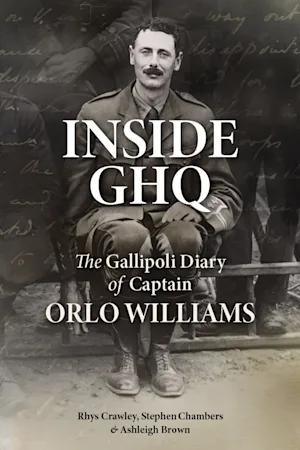
Most accounts of the Gallipoli campaign are written with the benefit of hindsight. Orlo Williams’ diary is not. Written day by day in a tiny, near-illegible hand, it records what was happening at General Headquarters as it happened – and often before anyone in authority knew about it.
In this talk, presented to the Gallipoli Association in July 2025, Dr Rhys Crawley – senior lecturer in history at UNSW Canberra, author of Climax at Gallipoli, and one of the editors of Inside GHQ: The Gallipoli Diary of Captain Orlo Williams – explains how the diary came to be published and why it matters.
Loading YouTube video...
Orlo was an unlikely figure for a military headquarters. Oxford-educated, fluent in five languages, and already the author of several books, he moved from a civilian role at the House of Commons to the War Office, where his experience handling secret documents made him an ideal cipher officer. At GHQ on Gallipoli, he was responsible for coding and decoding every top-secret telegram between the peninsula and London. He routinely read critical messages before the generals, before the War Cabinet, and before the Prime Minister.
He also wrote it all down – which he was emphatically not supposed to do.
The result is roughly 80,000 words of headquarters life as it was lived: the planning, the delays, the gossip, and the mounting frustration as the campaign stalled. Orlo was not kind to his superiors. He described senior staff officers as ‘fundamentally stupid’ and the campaign’s commander, General Sir Ian Hamilton, as a man with a ‘shallow at times obstinate mind’ who ‘never does anything at all.’
His position gave him a front-row seat to one of the campaign’s most dramatic moments: he was the officer who deciphered the telegram from Lord Kitchener that effectively sacked Hamilton. He also witnessed – and praised – the subsequent evacuation, calling it a ‘really great feat of organisation.’
Orlo brought a camera, too. Around 50 of his photographs appear in the book, most previously unpublished: the River Clyde with its sally ports cut into the hull, dead men in the trenches, officers crowded around makeshift tables above the beach.
Crawley’s talk also covers the considerable challenge of turning the diary into a published text. An earlier attempt by an American researcher – who read the entire manuscript into a dictaphone because it could not be photocopied – produced a transcription full of errors. The editors spent years working through Orlo’s handwriting to produce a reliable, annotated edition.
Orlo’s own verdict on the campaign was characteristically pointed: a warning against placing ‘undue confidence in cabinets.’ It remains sharp reading, more than a century on.
Inside GHQ: The Gallipoli Diary of Captain Orlo Williams is edited by Rhys Crawley, Stephen Chambers and Ashleigh Brown, and published by Little Gully.