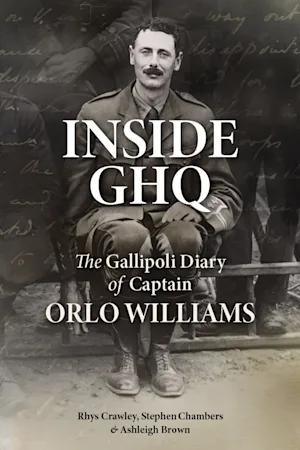
While the trenches of Gallipoli are well-documented, what actually happened behind the scenes at General Headquarters? One book, Inside GHQ: The Gallipoli Diary of Captain Orlo Williams, pulls back the curtain on the command center of the campaign. We are pleased to feature a review by esteemed historian Dr Mesut Uyar, who describes the diary as a “rollercoaster” of suspense, gossip, and sharp intellectual observation. From Orlo’s “unpretentious” voice to his unique insights into legendary figures like Kitchener and Hamilton, find out why Dr Uyar considers this book an essential read for anyone seeking the full story of the campaign…

Inside GHQ: The Gallipoli Diary of Captain Orlo Williams, by Orlo Williams, Rhys Crawley (Editor), Stephen Chambers (Editor), Ashleigh Brown (Editor), Little Gully Publishing, 2025, xii + 415 pp.
Unlike other so-called “Oriental side shows,” the Gallipoli Campaign remains immensely popular, and library shelves are groaning under the weight of an ever-increasing number of books. This is not a new phenomenon. From the very beginning of the campaign, combatants from all sides, as well as journalists, felt an urge to record their observations and experiences. Consequently, we are blessed with thousands of memoirs, diaries, and other personal narratives, though only a small percentage of them have been published. This raises the question: do we really need more books about the Gallipoli Campaign?
In the case of Captain Orlo Williams’s diary, the answer is a definite yes. While the popular understanding of the First World War locates the personal experience of war firmly in the trenches, Orlo’s diary provides a revealing and hitherto largely overlooked account of the day-to-day operations of an operational-level headquarters. As a cipher officer, Orlo was well-positioned to observe the inner workings and personalities of the General Headquarters (GHQ) of the Mediterranean Expeditionary Force. His position made him essential, yet simultaneously invisible, as he held no command or operational responsibilities. He was, essentially, the forgotten figure in the corner of a group photo of celebrities.
Orlo, however, possessed the intellectual capacity for observation and the literary talent to capture his thoughts in fluent prose. His diary entries offer not only unique insights into the daily functions and sometimes mundane affairs of GHQ, but also tantalizing glimpses of gossip, intimate thoughts, and deep emotions.
Orlo was a gifted diarist. His entries capture both major daily events and personal feelings remarkably well. Unlike the so-called diary of his superior, General Ian Hamilton, Orlo’s honesty and attention to detail hook the reader immediately. Like a novelist, Orlo takes the reader on a rollercoaster ride through the unfolding military campaign—sometimes moving smoothly, other times full of action and suspense. One feels a sense of regret that our reliable observer was unable to witness the April 25 landings from a broader vantage point to provide more detail. However, when he did have an opportunity, Orlo used it to the fullest—most notably in his account of the decision-making process for the evacuation of the Gallipoli Peninsula. His perceptive comments on Hamilton and Kitchener are particularly valuable.
In addition to providing an accurate picture of GHQ, Orlo reveals the motivations and functions of keeping a diary. It is apparent that, as a highly trained citizen-soldier, Orlo tried very hard to use writing to cope with his experiences of war. He used the pages not only to celebrate victories and achievements but to unload his emotions as discreetly as possible. This is why he wrote of literature, music, horse riding, and gossip; these were elements of civility that helped him stay sane and recover from the shock of loss. While Orlo did not appear to keep this diary for public consumption, the way he presents events and observations suggests he wanted to set the record straight—as seen in his criticisms of Kitchener, Hamilton, Birdwood, and Cecil Aspinall (the future official historian of the campaign), and his praise for unsung heroes like General Monro, Wyndham Deedes, and Guy Dawnay. It is not surprising, then, that he donated his diary to the Imperial War Museum shortly before his death.
The editors have done a terrific job, not only in uncovering this golden nugget from a dark corner of the archives but also in adding helpful summaries of the campaign at the start of each chapter to guide the reader.
In conclusion, I strongly advise serious readers of the Gallipoli Campaign to obtain a copy of this insightful and frank diary of a modest and unpretentious citizen-soldier.
Mesut Uyar
The University of New South Wales, Canberra, Australia