Jeanne Antelme’s Mudros, 1915 – published by Little Gully in a new English translation – is the memoir of a French volunteer nurse who served at the rear base of the Gallipoli Campaign on the island of Lemnos. But Antelme was also a journalist, and not all of her wartime writing fits within the covers of that book.
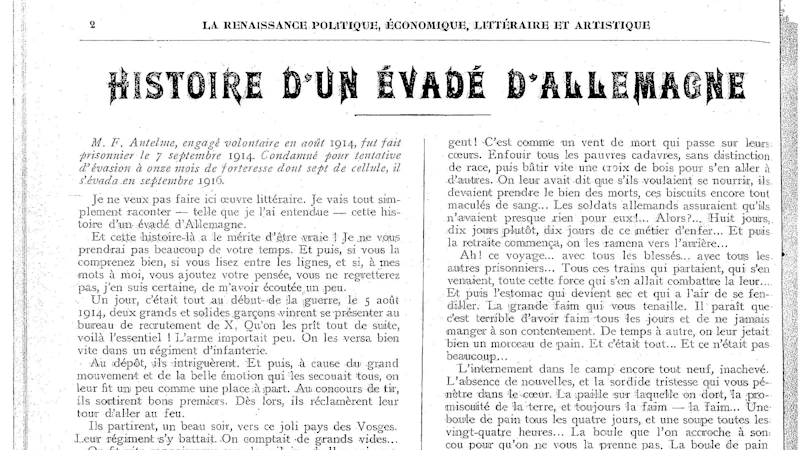
In February 1917 she published an account in the Parisian press of her brother Fernand’s captivity and escape from Germany.[1] The Antelmes were Franco-Mauritian – British subjects by nationality, French by culture – and Fernand had volunteered for the French army at the outbreak of war. He was captured within weeks.
After his return to France he transferred to the British military, training as a pilot with the Royal Flying Corps. His sister’s account of his captivity and escape is translated here for the first time, followed by a short biography tracing his path from the Vosges to the skies over Egypt and India.
Mr F. Antelme, having enlisted as a volunteer in August 1914, was taken prisoner on the 7th of September 1914. Sentenced for attempted escape to eleven months’ fortress imprisonment, of which seven were to be spent in solitary confinement, he escaped in September 1916.
I do not wish to produce a literary work here. I am simply going to tell – just as I heard it – this story of a man who escaped from Germany.
And this story has the merit of being true. I shall not take up much of your time. And if you understand it well, if you read between the lines, and if to my words you add your own thought, you will not regret, I am certain, having listened to me a little.

One day – it was at the very outbreak of the war, 5 August 1914 – two tall, strapping lads presented themselves at the recruiting office in X. To be taken at once: that was the essential thing. The branch of service mattered little. They were very quickly drafted into an infantry regiment.
At the depot, they attracted attention. And then, on account of the feverish excitement that gripped them both, they were set somewhat apart from the rest. In the shooting competition, they came first by a clear margin. From that moment, they demanded their turn to go into action.
They departed one fine evening for that lovely country of the Vosges. Their regiment was fighting there. The ranks already showed great gaps.
You soon made the acquaintance of those wicked bullets whistling past your ears, as if to warn you of their passage. And then, you only had to be on sentry duty to hear them wandering about you. Tac… toc… A sharp, dry sound, a snap, and a twig would slide down past your nose. Tac… tac… A dull thud, and it was a leaf’s turn to catch on your uniform.
The shells pursued you as if it were a game. Crack – and the blast of air threw you to the ground. Those devils, the Germans, had their fire well adjusted. At 1,000 metres, they dropped them right between your legs. Good God, how many of those poor soldiers were scattered to the winds. Then there were the wounded whom you could not abandon, who had to be taken to the dressing station. The poor lads begged not to be left behind. And so, despite the shells that kept raining down on you, you picked them up, one by one.
And you fought by day and by night.
One evening, you pushed forward. There was a sense of unease all around. The moon was waxing in the sky, but it was hard to breathe. The beeches and firs gathered great heaps of shadow at their feet. You could scent mystery in the air. From time to time, you stumbled over corpses. Death, always, everywhere. No one spoke. You passed hard by abandoned farms, so dismal in the solitude that enshrouded them.
The day came when the order was given to hold at all costs. And they fulfilled their mission. They found themselves surrounded. They employed every ruse and stratagem. Bandoliers were emptied, all provisions exhausted. The hours, then the days slipped away – and alone, abandoned, they were finally taken despite their resistance, in the shell-hole they inhabited. This took place on 7 September 1914.
They were disarmed, not without difficulty. That particular ceremony is never without pain when you still have the will to fight. But all the same, human strength has its limits, and despite the great cry of the soul and the atrocious sorrow, you had to bow your head.
The days that followed? Ah, the misery – when they think of it. It is like a wind of death passing over their hearts. Burying all the poor corpses, without distinction of race, then quickly fashioning a wooden cross before moving on to others. They had been told that if they wished to eat, they must take the belongings of the dead – those biscuits still stained with blood. The German soldiers insisted they had almost nothing for themselves. Well then? Eight days – ten, rather – ten days of this hellish business. And then the retreat began; they were taken to the rear.
Ah, that journey – with all the wounded, with all the other prisoners. All those trains departing, arriving, all that strength going off to fight theirs. And your stomach contracting, feeling ripped apart. The great hunger gnawing at you. It seems it is terrible to be hungry every day and never eat your fill. From time to time, they were thrown a morsel of bread. And that was all. And it was not much.

Internment in a camp still brand-new, unfinished. The absence of news, and the sordid sadness that seeps into your heart. The straw on which you sleep, the closeness of the earth, and always the hunger – the hunger. A ball of bread every four days, and a bowl of soup every 24 hours. The ball of bread you hang around your neck so that nobody takes it. The ball of bread you sleep with at night, to be sure of finding it in the morning.
The boots that dig into your flesh, penetrating so deeply they eventually numb the pain. The civilians – the deported civilians – the old men, the women and the children waiting in the neighbouring camp, suffering and dying. And the hunger again – always – always the hunger.
That existence lasted five months.
Five months? It does not sound like much, but five months of misery, five months during which you learned that the enemy had won battles and during which you had nothing but black bread. And then the cold, the mud, the hunger – the real misery – the great moral and physical desolation.
When improvements came and parcels began to arrive – it was in January, I believe. Just one month later, they escaped. They procured civilian clothes, which they buried where they usually went on work detail. And then, when the snow had covered the ground in a fine thick layer, they slipped into a ditch, between the sentries. There were four of them setting out. It took a good five hours to cover a hundred metres and slide, sheltered by the snow, beyond the perimeter.
They marched after that, by day, by night. They consulted compasses, pored over maps. The countryside grew ever whiter. They ran along the edges of woods, crossed villages, and pressed always further on.
And then, one afternoon, they found themselves accosted by an innkeeper:
‘Where are you going? Have you got papers?’
In reply, they spread out a yellowed old parchment on which some fine Turkish stamps lent an air of majesty. The man turned the paper over and over. They were about to set off again when he thought better of it:
‘And the other comrades?’
Things were turning sour. They parleyed. No use. He was holding on to their papers, the devil of a man – he was even going so far as to insist on them. What then? Soon the whole village would be up in arms. Better to risk ones last chance.
They made off in a hurry. Ah, the foul snow that came up to your knees, that pulled at your feet as if it, too, were in on it. Your legs went stiff and your joints cracked with pain. They ran a good few hours more, so strong was the reserve of hope. And despite the night, they had thrown themselves boldly into the heart of the forest. Then, around nine o’clock, the darkness being too deep, they stopped – hearts hammering in their chests, temples fit to split their skulls. They were done in, broken to the bone. And they strained their ears, listening for suspicious sounds in the distance.
They cut fine branches of fir, cold from having lain so long beneath the snow, and stretched out on them. And then, upon my word, they fell sound asleep. They could go on no longer.
It was just eleven o’clock when one of them felt a point pressed against his chest; at the same time, someone was pulling him by the leg. He started up, opened wide his eyes, which were blinded by lanterns. He made out a crowd of people howling at the top of their voices, just like wild animals. The din was appalling. Old men, adults, gendarmes – all surrounded them. He turned to his comrades. There too they were being threatened; a sabre was raised above their heads. And at the sight of this commotion, all four burst out laughing. It was so grotesque.
The chains were brought out.
‘French soldiers do not allow themselves to be chained.’
‘French!’ exclaimed the Bavarians.
‘Yes, French!’
‘French…’
The chains were put away and explanations exchanged. They had been taken for criminals. All the same, they had to go back to the village, where the crowd gathered around them. The women pitied them at the thought they would be shot. ‘Oh, these French! Nicht Disziplin.’ They were given food. And off they set again, limping along, legs worn out, broken with fatigue. Now they understood clearly that they would not be returning to France any time soon. And they no longer felt the slightest urge to laugh.
And then a NCO arrived and demanded the chains, he did. They spent the night in a cell. The very next day they were sent to the Kommandantur at Nuremberg. They crossed the entire city, chained and escorted by the mob. French! French!’ And still they were told: 'Why did you try to escape? You are going to be shot!’ At the Kommandantur, the duty officer had the chains removed at once. Orders were then given to place them in the Russian camp at G–, having first separated them. One was put to each company.
Ah, the wretched life that began again – the base, stupid, cold existence. The Russians did not understand French and the French did not know Russian. It was isolation and sordid closeness. The thousand little creatures running over your skin, roaming the length of your clothes and hiding in the straw of your bedding. And always the hunger returned. They shared, those great hulking soldiers – gentle as children, strong as lions – even as they themselves were dying of hunger, they shared their wretched rations with the Frenchman. Thin soup was ladled into an old pail picked up from a rubbish bin. Five or six of them dipped into it, and the Russians would say:
‘Eat, comrade, eat.’
And one day they witnessed a pitiful scene. A Russian soldier, no longer able to bear his hunger, had picked up a potato at the kitchen door. A German sergeant spotted him and set about chasing him, lashing him with a riding crop. The man collapsed.
Then my escapee threw himself at the brute. He was about to deal the fatal blow when his comrades held him back. It would have meant death. But what did it matter? He was dragged back to his barrack by force.
Another day, they performed an autopsy on a Russian soldier. In his stomach were 16 herring heads, in a state of complete putrefaction, picked up on the way to a work detail.
The court martial followed. The hearing, the arguments. And yet again, the German general declared that he understood perfectly that a soldier should seek to return to the field of hostilities in order to fight again, and that he commended them for it. They were sentenced nonetheless to eleven months imprisonment.
Down there, in the fortress of Oberhaus, the old mediaeval castle, life was almost tranquil. The food, compared with what had gone before, was not too bad. You ate.

Two months passed. The fortress was filling up with German soldiers. Room had to be made. They were sent to Nuremberg, to the cellular prison for common-law detainees – partly, too, as a reprisal.
No more shared quarters, but the cell, isolation, silence. The silence haunted by waking nightmares, with the endless crash of heavy ironwork, weighty keys, bells ringing at full peal and at every turn. An intolerable, atrocious noise within the silence. Oh, the silence peopled with nervous anguish, with infinite desolation. A silence that amplified the slightest sounds and sent them echoing. The faintest rustlings clung to your hearing, hammering at it painfully. Your head was battered, and a vile shiver ran the length of your body. And you would start, feeling a shock through your entire being, when the guard cracked open the hatch to slide in your rations and to watch you. To be alone and never to be alone – the dreadful subjection of it.
You could hear all the clocks of the city, too, coming back always, striking always, always. Your task was to mend sacks. And you took the opportunity to gather up the grains of wheat and barley that remained in them. You ate them to cheat the hunger a little – the great hunger that grew fiercer by the day. You were barely fed at all – to say nothing of the undrinkable malt on waking, a piece of black bread and a ladle of hot water in which a few grains of maize were lost, at eleven o’clock and at six. And that was all. Parcels and letters no longer had the right to reach you. You felt yourself going mad.
Each day, you were taken for exercise for three-quarters of an hour. This exercise consisted in walking one day in the prison yard and the next in a space I shall describe presently. In the yard, you walked five metres apart, round and round in a circle. Forbidden to say a word to one another, on pain of five to fifteen days in the punishment cell. The cell without light, a plank for a bed, the daily piece of bread and soup every three days. On top of which, you lost the right to write the one letter permitted every two months.
For having said ‘good morning’ to one of his comrades, the escapee of whom I always speak was sentenced to five days in the punishment cell. The first hours were terrible. Then he thought of his neighbours. By means of certain agreed taps, they managed to understand one another. And so they began a long conversation. It was an infantry captain who told him, in this way, about the Champagne offensive in which he had taken part. The Morse system filled the days.
When you were not walking in the yard, you were taken with the common-law prisoners to their exercise ground. An exercise ground laid out like a great wheel, with the hub being the guards cage, raised above the ground. Each spoke was a wall two metres high and 40 centimetres thick. One prisoner was placed between each pair of spokes, and for three-quarters of an hour they could walk back and forth. The common-law prisoners had their heads covered with black hoods. You could never recognise them, and they could never recognise one another. The eternal prison. Oh, how they suffered then.
On Sundays, you went to Mass, always with the same ceremony. You were locked in little wooden boxes, well separated from one another and solidly bolted. An iron grille, and facing you the high altar, flanked by a guard on either side. That was all you could see. So you sang the hymns, just to hear your own voice.
Then you came back to the cell. The doors slammed. You heard the entire mechanism of the locks working without mercy. And the bells came at you again, and the chimes of the clocks.
This life in the cell? It seems you cannot form any idea of it, and that those of us who live without privation cannot begin to imagine it. When you come back exhausted from those three-quarters of an hour of exercise and you do not even have the right to stretch out on your iron bed, and you must sit upright on your wooden bench, and the silence returns with all the other noises, you must hold your head in both hands to stop it leaving you altogether.
Seven months of solitary. And then, once more, the daylight, the air – the camp, which seemed almost like paradise. You received letters now, you opened parcels, you cooked and you talked. There was the news to be read, the good news arriving from France.
And then the days passed, and their primary obsession returned. To leave, to go back and fight. And it was the eye and the ear that searched for the smallest clue.
A railway wagon stood there, being loaded. To slip inside like a thief (7 September 1916), to burrow beneath the stacks of crates and let yourself be covered without a sound. The wagon was sealed now, and it waited for its destination. You were suffocating, and your whole body ached. You could hear, right beside you, against the wall of the wagon, the sentry leaning against it. And then his footsteps, tapping the ground. The hours passed; night came. And then day again, the anguish, and then night once more. You guessed all this from the comings and goings. Forty-eight hours had elapsed and the wagon was still motionless. And you had not moved either. You could not move. At last it set off. A kilometre further on, the train stopped again, and a whole long day went by.
The wagon had been coupled, and now, for good this time, it moved. Fever burned in your head while you felt your temples beating harder and harder. The wagon jolted on the rails. Other trains brushed past you. Only the noise of whistles and engines reached you. Everything was diffuse in that darkness. It seemed you were far, far away, and yet every jolt of the train struck you like a great blow to the chest. The train seemed to be breaking apart, and you were thrown from side to side. You could barely slip the neck of the bottle between your lips – the bottle in which you had put your water. You had to ration it, be sparing. The days went by. You heard, indistinctly, distant and nearby voices calling out: 'Carlsruhe.’
And the days fell away. Five, six days. The door was opened. The wagons were unloaded. The crates were removed one by one. And then the leap from the wagon, and freedom.
—Jeanne Antelme

Fernand Antelme
Fernand (Paul Fernand) Antelme was born on 18 August 1888[2] in Mauritius to Louis Edgar Antelme and Léontine Couture. Although a British subject by nationality, Fernand was – like his older sister, Jeanne – culturally French.
The summer of 1914 found Fernand in Lausanne, Switzerland, alongside his close friend and fellow Mauritian, Frank de Chazal Mayer.[3] Upon the declaration of general mobilisation, the two men travelled immediately to France to volunteer, presenting themselves for enlistment on 5 August 1914. However, their induction was initially obstructed by military bureaucracy regarding foreign nationals; Mayer later noted that he would “never have succeeded” in joining without Fernand, who leveraged his social connections to mobilise the local Prefect and the British Consul. They were finally accepted into the 10th Company of the 52nd Infantry Regiment (52e Régiment d’Infanterie) based in Montélimar.
Fernand and Mayer were thrust into the violent Battle of the Frontiers in the Vosges sector. The regiment disembarked at La Chapelle-lès-Bruyères on 7 August and engaged in the offensive to cross the passes of Sainte-Marie and Bonhomme. The following weeks (August 10–30) saw the regiment engaged in twenty-four battles in thirty days, enduring brutal mountain warfare, artillery barrages, and fighting retreats through villages such as Saint-Blaise-la-Roche and Raon-l’Étape. It was during these chaotic movements that the two friends were separated; Mayer was wounded and evacuated to Grenoble.
Fernand’s war was short but intense. By early September 1914, the 52e R.I. was fighting desperately to hold the Meurthe valley. The regimental history describes the period of 4–6 September as chaotic, with the regiment suffering heavy casualties defending the village of La Salle and reconstituting near Mailleufaing under constant pressure.[4]
On 7 September 1914, just 33 days after enlisting, Fernand was captured by German forces. He spent approximately two years as a Prisoner of War, during which time he proved to be a difficult captive. In 1915, he made his first escape attempt, trekking 125 kilometres through enemy territory before being recaptured. He was court-martialed and sentenced to eleven months in prison, a punishment reportedly mitigated only by the diplomatic intervention of the Queen of Denmark.
His internment finally concluded with a successful escape in 1916. Fernand and three French comrades concealed themselves inside a large, empty biscuit packing case being returned to Basel, Switzerland. Upon the crate’s arrival at the Baden railway station in Basel, the four men broke out and ran, believing they were still in enemy territory, until Swiss locals informed them they were safe. Due to his status as a British subject serving in French ranks, the French Consul in Basel, Monsieur de Maricourt, was unable to process his immediate repatriation. Fernand was required to report to the British Legation in Bern before successfully returning to France, where he was awarded the Croix de Guerre on 13 September 1916.[5]
Following his return to Allied lines, Fernand transferred to the British military, receiving a commission as a Probationary 2nd Lieutenant in the Royal Flying Corps (RFC) on 12 January 1917.
His initial flight training in the United Kingdom followed the standard curriculum of the era, transitioning from ‘pusher’ biplanes to tractor configurations. His RFC service record[6] documents a diverse array of aircraft, including the Maurice Farman Shorthorn and Longhorn, the Airco DH.6, and the standard Avro 504 trainer. His training also extended to operational types such as the Airco DH.2 and FE.2b pusher fighters, the BE.2c/e reconnaissance platforms, and the Bristol Scout. Fernand was graded a Flying Officer on 22 May 1917 and confirmed in his rank on 13 June 1917.
On 19 July 1917, he embarked from Southampton aboard the transport Saxon, bound for the Middle East Brigade. He arrived in Alexandria and was posted to No. 22 Training Squadron at Aboukir on 7 August 1917. Aboukir was a hub of intense activity during this period; the training wings were operating at capacity, often plagued by mechanical shortages and high accident rates due to the mix of inexperienced pupils and environmental hazards.[7]
Fernand became a casualty of this high-tempo environment almost immediately. On 13 August 1917, while piloting an Avro 504 (serial 4786), he was involved in a mid-air collision with a BE.2c (serial 4712), piloted by 2nd Lieutenant H.J.T. Russell.[8] Fernand sustained severe injuries. He spent the remainder of August and September 1917 recuperating.
Upon his recovery, he was transferred to the School of Aerial Gunnery at Heliopolis (Cairo) on 1 November 1917. He spent the winter of 1917/18 completing his advanced training, gaining the necessary skills for a posting to the front.

On 22 March 1918, Fernand departed Suez aboard the transport KaraDeniz, bound for Bombay to support the expanding air operations in India. With the formation of the Royal Air Force on 1 April 1918, he was promoted to Lieutenant.
On 25 September 1918, Fernand was posted to No. 114 Squadron. Established at Lahore in late 1917, the squadron was tasked with army co-operation and policing duties on the North-West Frontier. Fernand remained with the squadron through the Armistice and was listed as an Aeroplane Officer on 3 February 1919. His transfer to the Unemployed List on 14 October 1919 marked the end of his military service.
Following the war, Fernand emigrated to Argentina – a common destination for the Anglo-French diaspora involved in agriculture. He married Karin Margarita Boyer in 1930, with whom he had three children: Juana, Louis and Norman. He died in Argentina on 24 April 1960, aged 71.
‘Histoire d’un évadé d’Allemagne’ by Jeanne Antelme, La Renaissance (Paris), 17 February 1917, pp. 2-4.
↩British military records give 15 July 1888.
↩Private Papers of F de Chazal Mayer. Imperial War Museum, Documents.4828. See also chazfest.com/portfolio-items/franck-de-chazal-mayer/.
↩Historique du 52e régiment d’infanterie pendant la guerre 1914–1918, Berger-Levrault (Paris), n.d.
↩L’Intermédiaire des chercheurs et curieux (Paris), 15 March 1938, p. 225.
↩AIR 76/9/110. Royal Air Force officers’ service records 1918-1919. The National Archives, Kew.
↩Ray Vann and Mike O’Connor, ‘Wings Over Suez: The History of RFC/RAF Training in Egypt 1916–1919.’ Mick Davis, ‘RFC/RAF Training Units in Egypt.’ Cross & Cockade International, Spring 2016, Vol. 47/1.
↩Casualty card, ‘RFC people’ database, airhistory.org.uk.
↩